DAI
RAMP UP East 2011 Survey Report - Puli Alam
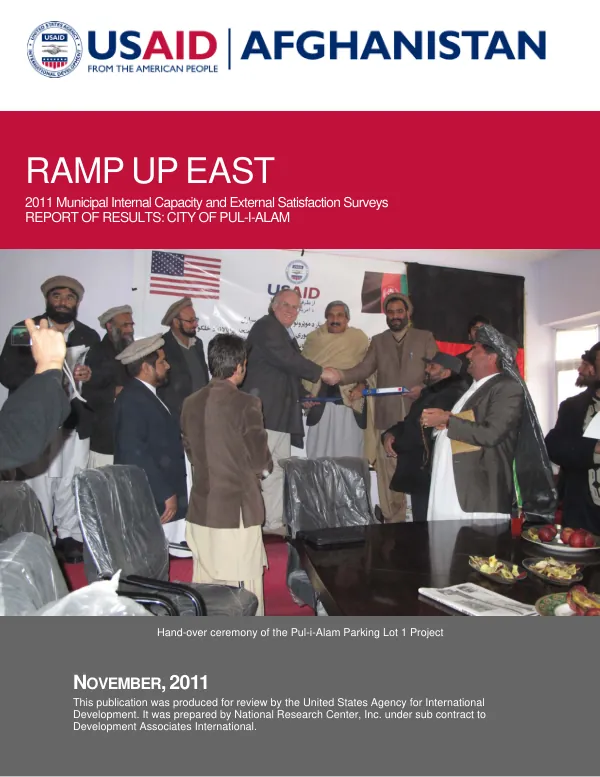
The City of Pul-i-Alam, located in the Regional Command East of Afghanistan, underwent a municipal internal capacity and external satisfaction survey in 2011 as part of the Regional Afghan Municipalities Program for Urban Populations (RAMP UP East).
2011 · 114 pages
Sign in to readA free account is required to download.
Abstract
The survey aimed to assess the city's internal capacity and external satisfaction, with a focus on municipal governance, public works, financial management, and revenue enhancement. The survey revealed that the city's municipal government had a well-defined organizational structure, with a clear municipal vision, mission, and goals. The municipal council met regularly, with a frequency of 12 meetings per year, and had a total of 25 employees. The municipality had established partnerships with various business entities and donors, including the International Development Law Organization (IDLG) and the Directorate of Municipal Affairs (DMA). In terms of public works, the city had a comprehensive plan for road maintenance, public parks maintenance, and latrine maintenance. The municipality had designated a dump site and implemented a trash collection plan. The public works department had a systematic filing system and a computer network, with a total of 15 employees. The financial management capacity of the municipality was assessed through a survey of its financial management systems, including accounting, budgeting, and cash disbursement procedures. The survey revealed that the municipality had a general ledger system and written procedures for disbursing cash, including recording disbursements. The financial management department had a total of 10 employees and a computer network. The revenue enhancement capacity of the municipality was also assessed through a survey of its revenue collection systems, including fees and taxes collected. The survey revealed that the municipality had a systematic filing system and a computer network, with a total of 5 employees. The municipality collected various fees and taxes, including property taxes, business licenses, and water and sewage fees. The survey also included a resident survey, which aimed to assess the quality of life in Pul-i-Alam. The survey revealed that the residents of Pul-i-Alam were generally satisfied with the services provided by the municipality, including public works, financial management, and revenue enhancement. However, there were some areas of concern, including the lack of access to clean water and sanitation facilities. Overall, the survey provided a comprehensive assessment of the municipal internal capacity and external satisfaction of the City of Pul-i-Alam. The findings of the survey can be used to inform policy and programming decisions aimed at improving the quality of life in Pul-i-Alam and enhancing the capacity of the municipality to provide effective services to its residents. The survey findings can be used to inform policy and programming decisions aimed at improving the quality of life in Pul-i-Alam and enhancing the capacity of the municipality to provide effective services to its residents.
Related documents