USAID DEC
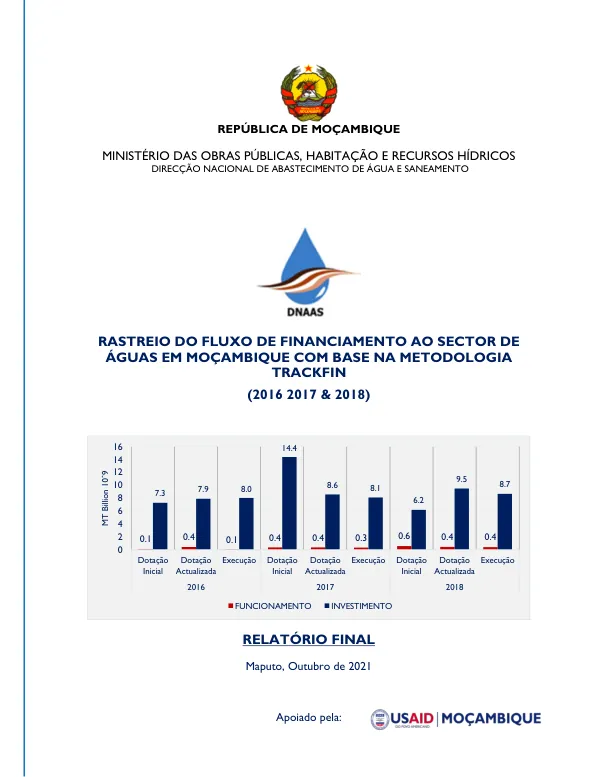
RASTREIO DO FLUXO DE FINANCIAMENTO AO SECTOR DE ÁGUAS EM MOÇAMBIQUE COM BASE NA METODOLOGIA TRACKFIN
Sign inUSAID DEC
RASTREIO DO FLUXO DE FINANCIAMENTO AO SECTOR DE ÁGUAS EM MOÇAMBIQUE COM BASE NA METODOLOGIA TRACKFIN
The Republic of Mozambique's Ministry of Public Works, Housing and Water Resources, through the National Water Supply and Sanitation Directorate, conducted a tracking of the financial flow to the water sector in Mozambique using the Trackfin methodology for the years 2016, 2017, and 2018.
2021 · 59 pages
Sign in to readA free account is required to download.
Abstract
The study aimed to analyze the trends in the sector's budget and expenditure. The sector's budget and expenditure trends were analyzed using the Trackfin methodology, which involves tracking the financial flow to the sector from various sources. The study found that the sector's budget and expenditure have been increasing over the years, with a significant increase in the budget for the year 2018. The sector's budget for 2018 was approximately 14.4 billion meticais, which is a 27% increase from the previous year. The sector's expenditure was also analyzed, and it was found that the majority of the expenditure was on operational costs, which accounted for approximately 60% of the total expenditure. The remaining 40% was allocated for investment purposes. The study also found that the sector's expenditure on investment has been increasing over the years, with a significant increase in the expenditure on large-scale investments. The sector's expenditure was also analyzed by component, and it was found that the majority of the expenditure was on water supply and sanitation services, which accounted for approximately 70% of the total expenditure. The remaining 30% was allocated for other components, such as irrigation and flood control. The study also analyzed the sector's expenditure by institution, and it was found that the majority of the expenditure was incurred by the National Water Supply and Sanitation Directorate, which accounted for approximately 50% of the total expenditure. The remaining 50% was allocated among other institutions, such as the Ministry of Public Works, Housing and Water Resources and the provincial governments. The sector's expenditure was also analyzed by geographic location, and it was found that the majority of the expenditure was incurred in the central and northern regions of the country, which accounted for approximately 60% of the total expenditure. The remaining 40% was allocated among other regions. The study concluded that the sector's budget and expenditure have been increasing over the years, with a significant increase in the budget for the year 2018. The sector's expenditure on investment has also been increasing, with a significant increase in the expenditure on large-scale investments. The study recommended that the sector should continue to increase its investment in water supply and sanitation services to meet the growing demand for these services. The sector's expenditure on irrigation and flood control services was also analyzed, and it was found that the majority of the expenditure was on operational costs, which accounted for approximately 70% of the total expenditure. The remaining 30% was allocated for investment purposes. The study also found that the sector's expenditure on irrigation and flood control services has been increasing over the years, with a significant increase in the expenditure on large-scale investments. The sector's expenditure on other components, such as drainage and wastewater management, was also analyzed, and it was found that the majority of the expenditure was on operational costs, which accounted for approximately 80% of the total expenditure. The remaining 20% was allocated for investment purposes. The study also found that the sector's expenditure on other components has been increasing over the years, with a significant increase in the expenditure on large-scale investments.