MANAGEMENT SCIENCES FOR HEALTH
RDC-PROSANIplus Final Report
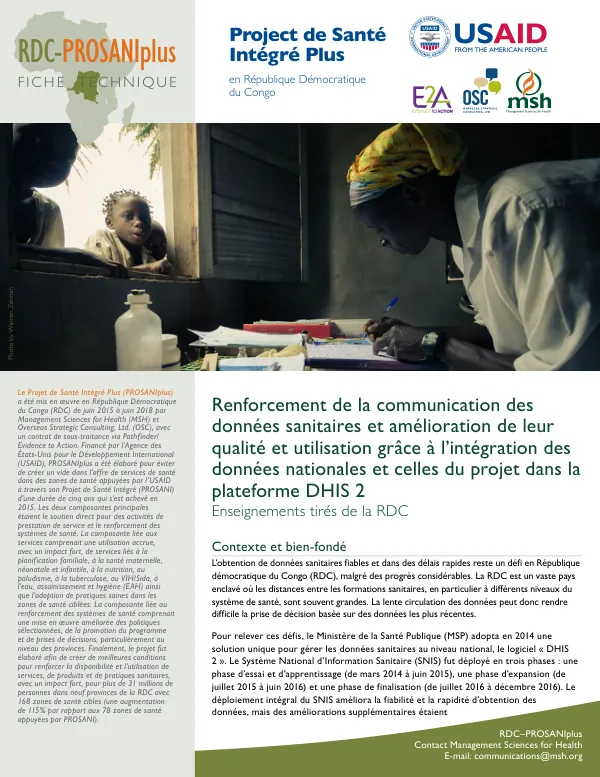
The Republic of the Congo's (RDC) health information management system faced significant challenges in obtaining reliable and timely health data.
2018 · 4 pages
Sign in to readA free account is required to download.
Abstract
Despite notable progress, the country's vast size and remote health facilities hindered data circulation, making it difficult to make informed decisions. To address these issues, the Ministry of Public Health (MSP) adopted the DHIS 2 software in 2014 to manage national health data. The System National d'Information Sanitaire (SNIS) was deployed in three phases: a trial and learning phase (March 2014 to June 2015), an expansion phase (July 2015 to June 2016), and a finalization phase (July 2016 to December 2016). The full deployment of SNIS improved data reliability and speed, but additional improvements were necessary. To address these challenges, PROSANIplus and the MSP's national health information division implemented several measures. A complementary module was created within the DHIS 2 system to collect data on project indicators not currently recorded in the SNIS (April 2017). Seventy-eight health zones covered by PROSANIplus were equipped with computers and stable internet connections to ensure uninterrupted use of SNIS (June to August 2017). The project's spreadsheets were abandoned, and data were extracted from SNIS (June 2017). A "data communication speed rate of 80%" was added to the list of indicators used for monthly payments to health zones (June 2017). Data managers in health zones received training on the complementary module to improve their skills (June 2017). Interoperability between the two systems (DHIS 2 of SNIS and that of PROSANIplus) was finalized (November 2017). These measures improved the speed of obtaining and disseminating routine health data from health zones supported by the project. The data communication speed rate now exceeds the national rate (Figure 1). The availability of data via DHIS 2, aligning systems, and integrating data significantly improved the speed of communication of health data (Figure 1). With data now available more quickly, it is possible to consider improving the reliability, analysis, and use of data at all levels of the health pyramid. To achieve this, PROSANIplus worked with the SNIS division to create and implement the following activities. An "Outil de Supervision de la Qualité des Données" (OSQD) tool was created and integrated into the DHIS 2 module of the MSP, allowing for its use on a tablet via the data capture extension of DHIS 2. This tool should be used monthly by health zone teams in some health facilities. Tables were created in the DHIS 2 module of the MSP to show variations in data quality and how improvement evolves over time at the health facility, health zone, and provincial health division levels, as well as at the national level. The main challenges faced were the instability of the political situation, which often led to the closure of health facilities within a year. PROSANIplus therefore extracted data from the DHIS 2 of the MSP at the health zone level, rather than the health facility level. Manual data entry by health zone data managers into the DHIS 2 did not follow the DSNIS protocol, including verification, correction, and approval during the monthly monitoring meeting, and could lead to data errors. Developing a culture of data analysis to understand what the data means for the program or service, and to inform decisions at each level of the system (health facility, health zone, provincial health division, central level) should be a priority. Poor mobile network coverage in some health zones (satellite solutions are not cost-effective) and a high rate of personnel turnover responsible for data in health zones were also challenges. Additionally, a lack of clarity in job descriptions meant that employees were not aware that the new task of data entry was part of their work. It took time for data entry to become a reality in health zones. The slowness in adopting new tools and directives by the provincial health division and health zone teams was also a challenge; after training, it took time for these tools and directives to be systematically used, as people continued to work with old methods.