USAID DEC
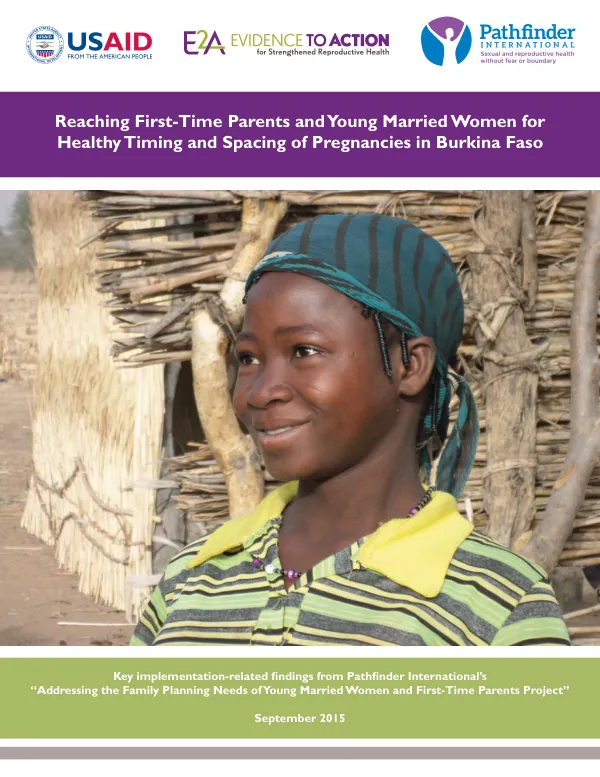
Reaching First-Time Parents and Young Married Women for Healthy Timing and Spacing of Pregnancies in Burkina Faso
Sign inINTRAHEALTH
Reaching First-Time Parents and Young Married Women for Healthy Timing and Spacing of Pregnancies in Burkina Faso
The Evidence to Action for Strengthened Family Planning and Reproductive Health Services for Women and Girls Project, also known as E2A, is a global initiative led by Pathfinder International in partnership with several organizations.
2015 · 56 pages
Sign in to readA free account is required to download.
Abstract
The project aims to address the reproductive healthcare needs of girls, women, and underserved communities worldwide by increasing support, building evidence, and facilitating the scale-up of best practices that improve family planning services. E2A was awarded in September 2011 and is a five-year project funded by the US Agency for International Development (USAID). In Burkina Faso, E2A implemented the "Addressing the Family Planning Needs of Young Married Women and First-Time Parents Project" to reach first-time parents and young married women for healthy timing and spacing of pregnancies. The project focused on engaging key influencers and gatekeepers, planning and running peer group discussions and home visits, and tailoring specific approaches to increase demand for family planning among first-time parents, young married women with no children, and young married women with multiple children. Community activities included small group discussions and engaging key influencers, which were monitored and documented using a specific methodology. The project covered a significant number of communities and reported quantitative results, including the number of participants and the percentage of women using modern family planning methods. Qualitative findings highlighted the importance of engaging key influencers, adapting activity cards to the context of Burkina Faso, and recognizing diversity and tailoring strategies accordingly. The project also emphasized the value of systematic qualitative monitoring and documentation, which helped to identify best practices and areas for improvement. A scalability assessment was conducted to determine the potential for scaling up the project's interventions, and the findings highlighted the importance of engaging a participatory process involving key stakeholders, ensuring the relevance of the proposed innovation, and tailoring the innovation to the sociocultural and institutional settings. The project's conclusions and recommendations emphasized the need for continued support and funding to scale up the interventions and promote learning and dissemination of information. The project's findings and recommendations have the potential to inform future family planning and reproductive health initiatives in Burkina Faso and beyond. In terms of implementation, the project focused on building young women's human and social capital and agency, which is critical for their reproductive health and well-being. The project also recognized the importance of engaging husbands and couples in communication for improved sexual and reproductive health outcomes. The project's methodology involved a combination of quantitative and qualitative approaches, including surveys, focus group discussions, and in-depth interviews. The project's findings were analyzed and presented in a report, which provides valuable insights into the project's successes and challenges. Overall, the E2A project in Burkina Faso has made significant contributions to the field of family planning and reproductive health, and its findings and recommendations have the potential to inform future initiatives and policies.
Related documents