USAID
Records Management Guide for Exiting Political Appointees
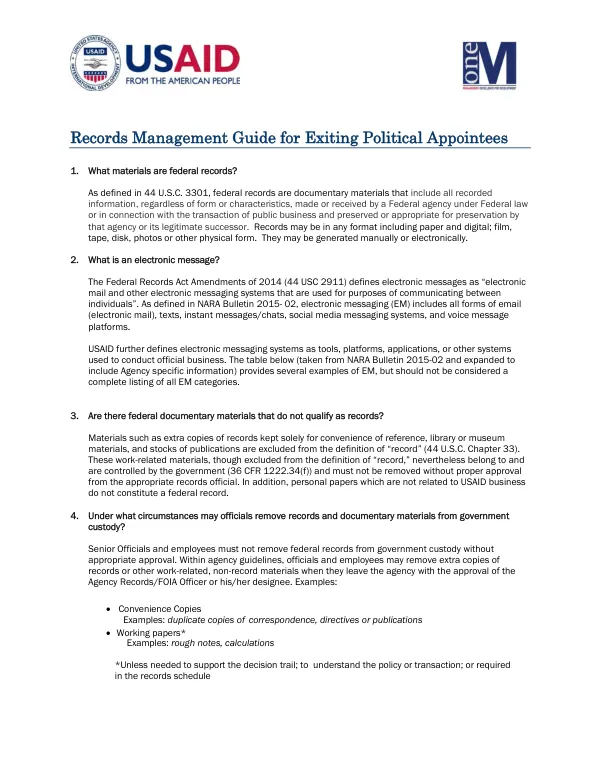
Federal records are defined as documentary materials that include all recorded information, regardless of form or characteristics, made or received by a Federal agency under Federal law or in connection with the transaction of public business and preserved or appropriate for preservation by that agency or its legitimate successor.
2016 · 4 pages
Sign in to readA free account is required to download.
Abstract
Records may be in any format, including paper and digital, film, tape, disk, photos, or other physical form, and may be generated manually or electronically. Electronic messages are defined as electronic mail and other electronic messaging systems used for purposes of communicating between individuals. This includes email, texts, instant messages/chats, social media messaging systems, and voice message platforms. USAID further defines electronic messaging systems as tools, platforms, applications, or other systems used to conduct official business. Materials that do not qualify as federal records include extra copies of records kept solely for convenience of reference, library or museum materials, and stocks of publications. These work-related materials, though excluded from the definition of "record," belong to and are controlled by the government and must not be removed without proper approval from the appropriate records official. Personal papers that are not related to USAID business also do not constitute a federal record. Senior Officials and employees must not remove federal records from government custody without appropriate approval. However, they may remove extra copies of records or other work-related, non-record materials when they leave the agency with the approval of the Agency Records/FOIA Officer or his/her designee. Examples of materials that may be removed include convenience copies, working papers, and personal materials. Records are to be maintained in official agency record keeping systems so that they will be integrated, either physically or intellectually, with related records and remain accessible to all staff that may need them. Senior Officials and employees are encouraged to keep personal files separate from official agency record content. When a record is no longer needed and has reached its retention requirement, it must be dispositioned in one of two ways – destruction or transfer – in accordance with the timeframe(s) prescribed in the mandatory file and disposition schedule found in ADS 502: The USAID Records Management Program. As part of the agency's exit clearance process, separating employees must complete the AID Form 502-2 – USAID Records Management Exit Checklist for Employees or AID Form 502-3 for Senior Officials before separating from USAID. The Records Liaison Officer and supervisor must verify that records have been handled properly according to USAID's records management policies. Senior Officials and employees should delete and remove all personal material from the agency system prior to departure. If an agency knows of any actual or potential threat to records, it must contact the National Archives and Records Administration (NARA), as required by 36 CFR 1228.104. NARA will assist the agency in contacting the Attorney General for the recovery of any unlawfully removed records. There are criminal penalties for the unlawful removal or destruction of Federal records and the unlawful disclosure of national security information or other information exempt from disclosure under the Freedom of Information Act and the Privacy Act. Further information on this topic is available within USAID, including additional information about records management, documentation of public service, and USAID's records management program. Contact the Bureau/Independent Office's Records Liaison Officer (RLO) or the Bureau for Management, Office of Management Services, Information and Records Division (M/MS/IRD) Records Information and Management Specialist (RIMS) for help.