USAID
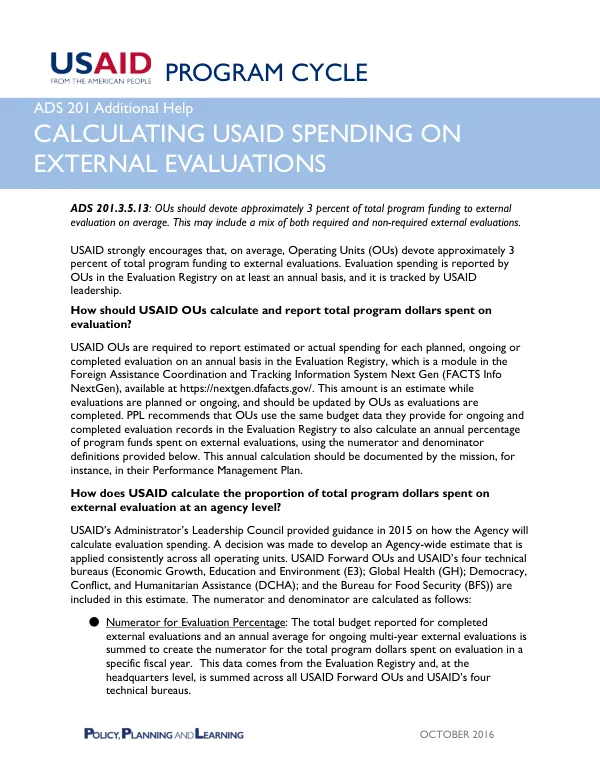
Calculating USAID Spending on External Evaluations
Operating Units (OUs) are required to devote approximately 3 percent of total program funding to external evaluation on average.
2016 · 3 pages
Sign in to readA free account is required to download.
Abstract
This may include a mix of both required and non-required external evaluations. USAID strongly encourages OUs to devote approximately 3 percent of total program funding to external evaluations. Evaluation spending is reported by OUs in the Evaluation Registry on at least an annual basis, and it is tracked by USAID leadership. To calculate and report total program dollars spent on evaluation, USAID OUs are required to report estimated or actual spending for each planned, ongoing, or completed evaluation on an annual basis in the Evaluation Registry. This amount is an estimate while evaluations are planned or ongoing, and should be updated by OUs as evaluations are completed. The Evaluation Registry is a module in the Foreign Assistance Coordination and Tracking Information System Next Gen (FACTS Info NextGen), available at https://nextgen.dfafacts.gov/. PPL recommends that OUs use the same budget data they provide for ongoing and completed evaluation records in the Evaluation Registry to also calculate an annual percentage of program funds spent on external evaluations. The numerator for the evaluation percentage is calculated by summing the total budget reported for completed external evaluations and an annual average for ongoing multi-year external evaluations. This data comes from the Evaluation Registry and, at the headquarters level, is summed across all USAID Forward OUs and USAID's four technical bureaus. The denominator for the evaluation percentage is calculated by using total obligations for a given fiscal year, which is sourced from USAID's accounting system, Phoenix. PIO transfers are excluded from that total. USAID uses the aggregated total to track trends in Agency evaluation spending over time and report on the status of evaluation spending to stakeholders. Disaggregated spending data will typically not be reported publicly, but will be used internally by managers to better understand and guide evaluation resources. The approach described above will be applied Agency-wide for initial analysis and to help compare across OUs. However, bureaus or OUs may decide to do additional analysis to better understand their evaluation spending in specific contexts. For example, bureaus may calculate estimates that exclude field support funds from the bureau's total program funding denominator, or show how spending would differ if specific accounts were calculated separately.