GOVERNMENT OF ETHIOPIA
Recurrent Monitoring Survey 2: Key Findings and Program Implications
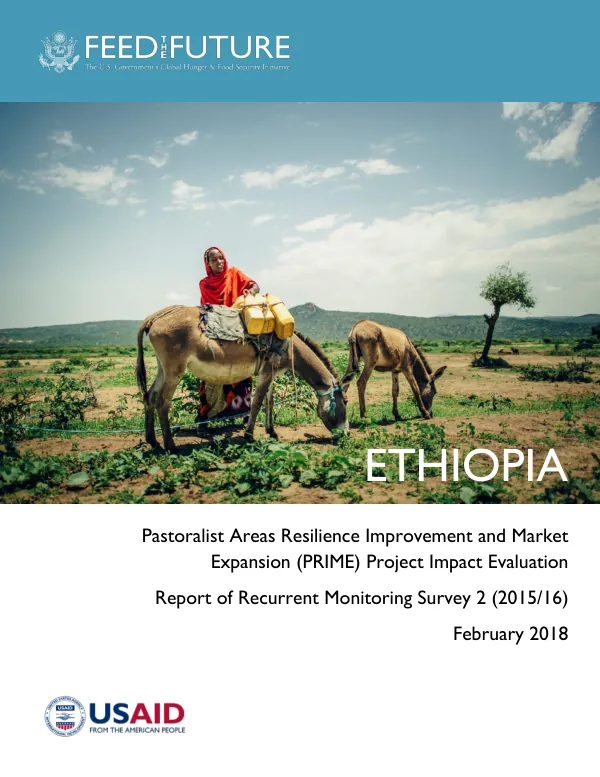
The Pastoralist Areas Resilience Improvement and Market Expansion (PRIME) project was launched in October 2012 in the drylands of Ethiopia, one of the most shock-prone areas of the world.
2018 · 4 pages
Sign in to readA free account is required to download.
Abstract
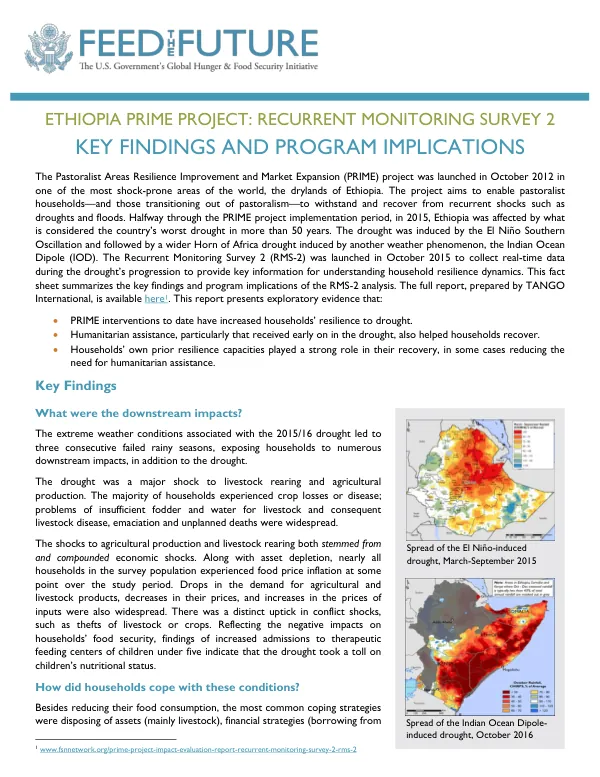
The project aimed to enable pastoralist households and those transitioning out of pastoralism to withstand and recover from recurrent shocks such as droughts and floods. In 2015, Ethiopia was affected by the country's worst drought in more than 50 years, induced by the El Niño Southern Oscillation and the Indian Ocean Dipole. The Recurrent Monitoring Survey 2 (RMS-2) was conducted in October 2015 to collect real-time data during the drought's progression. The survey provided key information for understanding household resilience dynamics. The analysis of the RMS-2 data revealed that PRIME interventions had increased households' resilience to drought. Humanitarian assistance, particularly early receipt of food aid, also helped households recover. Households' own prior resilience capacities played a strong role in their recovery, reducing the need for humanitarian assistance in some cases. The extreme weather conditions associated with the 2015/16 drought led to three consecutive failed rainy seasons, exposing households to numerous downstream impacts. The drought had a major impact on livestock rearing and agricultural production, with crop losses or disease, insufficient fodder and water for livestock, and consequent livestock disease, emaciation, and unplanned deaths widespread. Economic shocks, including asset depletion and food price inflation, were also experienced by nearly all households in the survey population. Households coped with these conditions by reducing their food consumption, disposing of assets, financial strategies, and relying on assistance from others. Many coping strategies were found to be declining over the time periods monitored, indicating widespread dwindling resources and income-generating opportunities. However, two coping strategies were on the rise, including drawing down on savings and receiving food aid from the government. The analysis of the RMS-2 data provided preliminary evidence that PRIME project interventions reduced the negative effect of drought exposure and had a positive effect on households' resilience. Households residing in communities receiving a comprehensive set of PRIME resilience interventions were able to maintain their food security in the face of the drought shock. The project reduced households' reliance on borrowing from money lenders and receiving help from non-family members with food and money, and increased borrowing from friends and relatives. Humanitarian assistance, including food aid and food/cash-for-work, had a positive effect on households' ability to recover from the drought. Early receipt of food aid further boosted households' recovery, reducing their reliance on negative coping strategies such as selling or slaughtering livestock, consuming seed stock, and relying on help from friends and family members. Households' own prior resilience capacities played a strong role in their recovery from the drought. These capacities included bonding and bridging social capital, human capital and exposure to information, access to safety nets, asset ownership, access to financial resources, cash savings, access to markets, availability of hazard insurance, disaster preparedness and mitigation activities, and the presence of a civic group in households' communities. The analysis of the RMS-2 data has several implications for programming. Comprehensive, multi-sectoral programming has helped strengthen household and community resilience capacities to manage drought. Protecting livestock assets from unplanned deaths through fodder and water provision, market off-take, and veterinary services can be critical to helping households manage shocks. Access to financial services and markets are also critical for diversifying livelihoods into activities not as susceptible to climatic risks. More focus must be given to promoting successful livelihood opportunities for people moving out of pastoralism. Social capital, which is critical to resilience, can be strengthened through group formations such as savings groups, natural resource management committees, pasture management groups, livestock marketing groups, etc. Projects need to do a better job tracking improvements in collective action as trust between group members increases. Using good trigger indicators to determine the timing, scale, and duration of formal cash and food transfers can be critical to enabling households to manage drought without turning to negative coping strategies. Early receipt of such transfers can lead to early recovery, reducing the need for extensive humanitarian assistance. Hazard insurance and disaster risk reduction interventions can also play a critical role in helping households manage droughts and their downstream effects.
Related documents
Documents in this collection
 2013
2013USAID DEC
Final Report: Expert Consultation on Measuring Resilience in the Face of Shocks and Stresses
Open record 2018
2018USAID DEC