USAID DEC
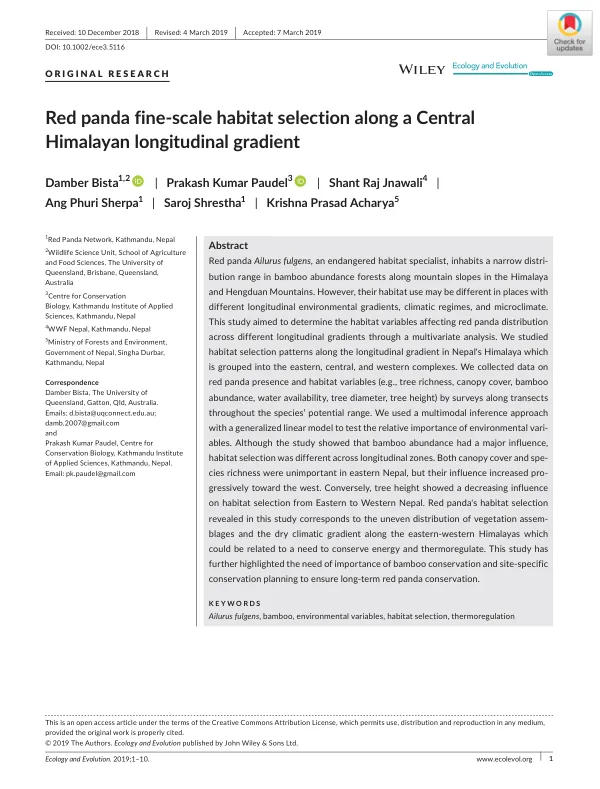
Red panda fine-scale habitat selection along a Central Himalayan longitudinal gradient
Sign inUSAID DEC
Red panda fine-scale habitat selection along a Central Himalayan longitudinal gradient
Red pandas inhabit a narrow distribution range in bamboo abundance forests along mountain slopes in the Himalaya and Hengduan Mountains.
2019 · 10 pages
Sign in to readA free account is required to download.
Abstract
Their habitat use may vary in places with different longitudinal environmental gradients, climatic regimes, and microclimate. This study aimed to determine the habitat variables affecting red panda distribution across different longitudinal gradients through a multivariate analysis. The study was conducted in Nepal's Himalaya, which is grouped into the eastern, central, and western complexes. Habitat selection patterns were studied along the longitudinal gradient, and data on red panda presence and habitat variables were collected by surveys along transects throughout the species' potential range. The variables included tree richness, canopy cover, bamboo abundance, water availability, tree diameter, and tree height. A multimodal inference approach with a generalized linear model was used to test the relative importance of environmental variables. The results showed that bamboo abundance had a major influence on habitat selection, but the influence of other variables differed across longitudinal zones. Canopy cover and species richness were unimportant in eastern Nepal but increased in importance towards the west. Conversely, tree height showed a decreasing influence on habitat selection from eastern to western Nepal. The study's findings correspond to the uneven distribution of vegetation assemblies and the dry climatic gradient along the eastern-western Himalayas, which may be related to the need to conserve energy and thermoregulate. Red pandas are found in certain clusters within a narrow 2,100-4,325 m altitudinal range, mainly in montane forests with abundant bamboo in the understory. The species has been reported from Kalikot District of Nepal in the west to the Minshan Mountain and upper Min Valley in Sichuan Province, China in the east. Nepal has highly heterogeneous landscapes in terms of elevation, with one of the longest elevational gradients within a short distance. The country is situated at the crossroads of the Paleotropic in the south and the Palearctic in the north, as well as at the confluence of several floristic regions. The study used data on canopy cover, bamboo abundance, size of trees, water availability, tree height, and tree species richness collected throughout the habitat of red pandas in Nepal. The results of the study are pivotal for devising an appropriate conservation strategy for the red panda, an iconic member of the fauna of these mountain forests. The study highlights the importance of bamboo conservation and site-specific conservation planning to ensure long-term red panda conservation.