USAID DEC
Development of a Microbiological Paper-Based Analytical Device to Detect Fecal Contamination of Water in Resource-Limited Settings
Sign inUSAID DEC
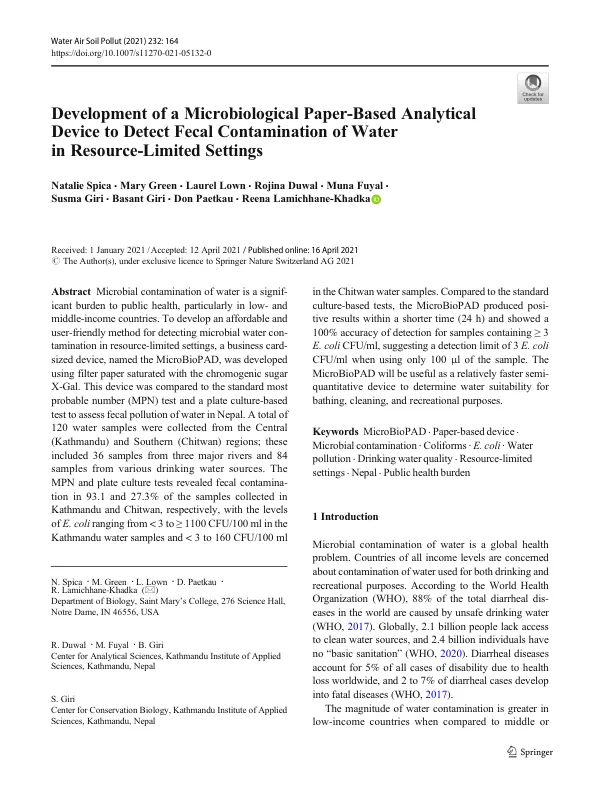
Development of a Microbiological Paper-Based Analytical Device to Detect Fecal Contamination of Water in Resource-Limited Settings
The MicroBioPAD is a microbiological paper-based analytical device designed to detect fecal contamination of water in resource-limited settings.
2021 · 12 pages
Sign in to readA free account is required to download.
Abstract
The device utilizes a common colorimetric test based on the hydrolysis of X-Gal sugar by the β-D-galactosidase enzyme produced by E. coli and some other coliforms. The enzymatic hydrolysis of X-Gal produces a visible blue color on the paper device, indicating a positive result. The MicroBioPAD was compared to the standard culture-based most probable number (MPN) method and a plate culture-based test to assess fecal pollution of water in Nepal. A total of 120 water samples were collected from the Central (Kathmandu) and Southern (Chitwan) regions, including 36 samples from three major rivers and 84 samples from various drinking water sources. The MPN and plate culture tests revealed fecal contamination in 93.1 and 27.3% of the samples collected in Kathmandu and Chitwan, respectively, with the levels of E. coli ranging from < 3 to ≥1100 CFU/100 ml in the Kathmandu water samples and < 3 to 160 CFU/100 ml in the Chitwan water samples. The MicroBioPAD produced positive results within a shorter time (24 h) and showed a 100% accuracy of detection for samples containing ≥3 E. coli CFU/ml, suggesting a detection limit of 3 E. coli CFU/ml when using only 100 μl of the sample. The device will be useful as a relatively faster semi-quantitative device to determine water suitability for bathing, cleaning, and recreational purposes. The MicroBioPAD was developed to address the need for a simple, portable, efficient, and affordable method for detecting microbial water contaminants in remote or resource-limited areas. The device is designed to be used in areas where water is scarce and extensive procedures or equipment are not available. The MicroBioPAD utilizes a common colorimetric test based on the hydrolysis of X-Gal sugar by the β-D-galactosidase enzyme produced by E. coli and some other coliforms. The MicroBioPAD was tested alongside the standard culture-based MPN method and the ECA-Check Easygel plate culture method to detect fecal contamination of water in Nepal. The results showed that the MicroBioPAD produced positive results within a shorter time (24 h) and showed a 100% accuracy of detection for samples containing ≥3 E. coli CFU/ml. The device will be useful as a relatively faster semi-quantitative device to determine water suitability for bathing, cleaning, and recreational purposes. The development of the MicroBioPAD is significant because it addresses the need for a simple, portable, efficient, and affordable method for detecting microbial water contaminants in remote or resource-limited areas. The device has the potential to improve public health in areas where access to clean water is limited. The MicroBioPAD can be used to detect fecal contamination of water in a relatively short time and with high accuracy, making it a valuable tool for water quality monitoring in resource-limited settings.