USAID DEC
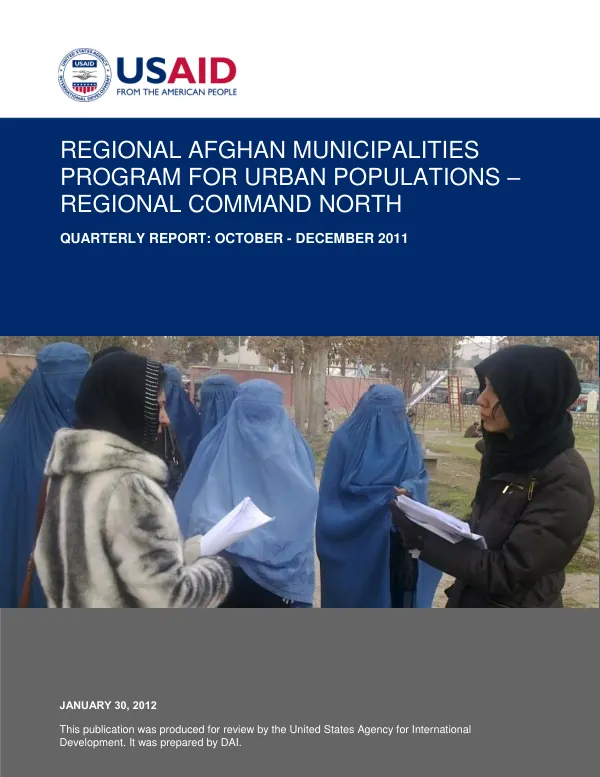
Regional Afghan Municipalities Program for Urban Populations (RAMP UP) – RC North Quarterly Report: October – December 2011
Sign inDAI
Regional Afghan Municipalities Program for Urban Populations (RAMP UP) – RC North Quarterly Report: October – December 2011
The Regional Afghan Municipalities Program for Urban Populations, Regional Command North (RAMP UP North) project's revised work plan was approved on December 2, 2011.
2011 · 32 pages
Sign in to readA free account is required to download.
Abstract
This approval clarified program goals and objectives, allowing RU-N to rapidly develop specific action plans for embedded team members. During this quarter, RU-N staff made notable progress, especially in terms of capacity building of municipal officials and citizen representatives, project planning and procurement, and citizen engagement and public awareness. Capacity building was a key focus for RU-N, with staff implementing project-based training to develop core competencies. Key municipal procurement officials and citizens in five municipalities received experienced-based training on transparent procurement processes, aligning with Afghan procurement laws. RU-N program staff introduced citizens and officials to the idea of Service Improvement Plans (SIPs) and assisted them in developing SIPs for several subprojects. RU-N staff also introduced municipal officials and citizens to concepts of project management, focusing on tools and concepts used for project selection and prioritizing needs, project planning, project sustainability assessments, and project monitoring. Citizens received firsthand training in assessing neighborhood needs and citizen monitoring. RU-N Sustainable Service Delivery Improvement Projects entered the second of four planned rounds, with Service Delivery Advisory Groups (SDAGs) and mayors prioritizing and selecting projects in many municipalities. Most of the first-round projects have entered the procurement stage, with five bid openings and evaluations held in December. One project, the Aybak central park improvement project, entered final stages. RU-N staff continued to involve citizens and municipal officials in all stages with a focus on project monitoring and oversight. Local media was present at several events, providing widespread exposure to increase public awareness of the work of RU-N. This exposure will help to amplify the project's message, build stakeholder partnership, and increase the probability of long-term, citizen-led financial sustainability through expanded revenues. The RU-N civil society team conducted several citizen beneficiary surveys, both pre- and post-project, to assess community needs and options for change. The team asked several questions to assess whether or not citizens were willing to contribute to project sustainability and how much their contribution might be. Initial findings point to a broad-based citizen willingness to pay more for basic municipal services. RU-N will complete analysis and share the results with mayors and SDAG members, and use the information in Round 2 project design. RU-N staff also worked closely with Mayors and community leaders to develop public awareness campaigns to inform the public about municipal projects and to begin to link expanded service to citizen financial support. The RU-N procurement team conducted a bid opening and capacity-building event on December 15, 2011, with SDAG members, municipal officials, and media representatives present. Capacity-building activities were embedded in all the work of RU-N, with staff passing along skills and tools to assist municipal officials and citizens perform their functions or roles in the municipal decision-making process more effectively. Concurrent with the implementation of the Sustainable Service Delivery Improvement Projects, RU-N technical experts introduced the concept of longer-term service delivery improvement planning. The purpose of the Service Improvement Plan is to lay a foundation for benchmarking service improvement goals, citizen monitoring, and sustainability. Citizens who were involved in drafting SIPs were instructed by RU-N staff on the importance of citizen participation in the planning and implementation of municipal projects. RU-N staff also worked with municipal officials to develop public awareness campaigns to inform the public about municipal projects and to begin to link expanded service to citizen financial support. The RU-N civil society team conducted several citizen beneficiary surveys to assess community needs and options for change. The surveys asked several questions to assess whether or not citizens were willing to contribute to project sustainability and how much their contribution might be. Initial findings point to a broad-based citizen willingness to pay more for basic municipal services. RU-N will complete analysis and share the results with mayors and SDAG members, and use the information in Round 2 project design.
Related documents