USAID DEC
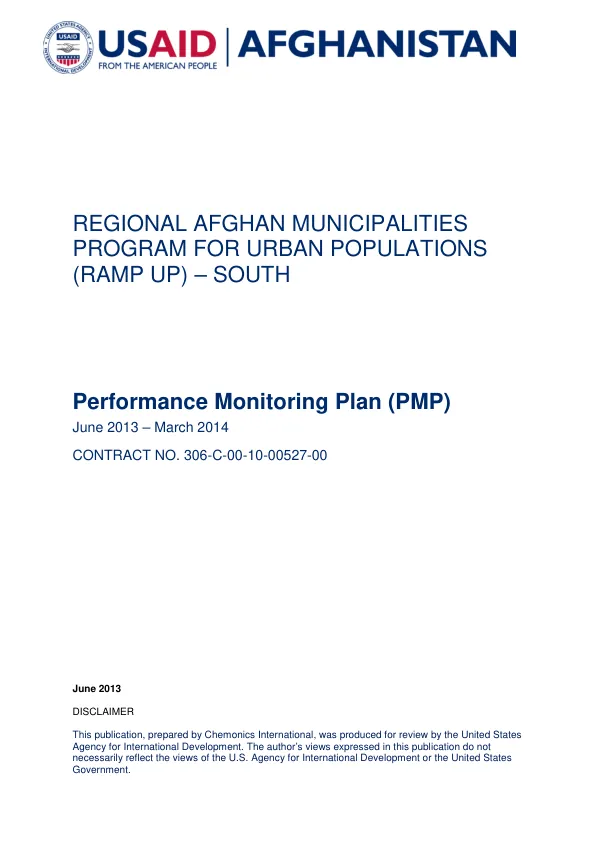
Regional Afghan Municipalities Program for Urban Populations (RAMP UP) – South Performance Monitoring Plan
Sign inCHEMONICS
Regional Afghan Municipalities Program for Urban Populations (RAMP UP) – South Performance Monitoring Plan
The Regional Afghan Municipalities Program for Urban Populations (RAMP UP) – South (RU-S) is a performance monitoring plan that outlines the program's development hypotheses and indicators for measuring progress towards its objectives.
2013 · 78 pages
Sign in to readA free account is required to download.
Abstract
The program aims to increase citizens' trust in, satisfaction with, buy-in, and support to municipal service delivery in target municipalities in Afghanistan. The RU-S program is part of the Regional Afghan Municipalities Program for Urban Populations, which is funded by the United States Agency for International Development (USAID). The program's development hypotheses are based on the relationships between the RU-S and USAID development hypotheses, as illustrated by the relationships between their respective Results Frameworks. The Performance Monitoring Plan (PMP) highlights the specific indicators and methodology that will be employed to test these hypotheses during the life of the program. The PMP incorporates a simple, form-based data collection process and an M&E data tracker for each program component. Monitoring and Evaluation (M&E) is an integral part of the decision-making process that integrates planning for the achievement of program objectives, conducting activities required to attain program objectives, monitoring of activities, and using resultant data to ensure that the program is making the required progress to achieve objectives. The RU-S program focuses on improving municipal capacity, increasing citizens' access to essential services, and generating revenue for target municipalities. The program's objectives are outlined in the Performance Indicator Reference Sheet (PIRS), which provides explicit detail on the indicators selected to monitor and measure both progress towards and achievement of developmental objectives of the RU-S program. The program's implementation is guided by the USAID Afghanistan Mission Objectives, which are outlined in Exhibit 1 of the PMP. The Results Framework, as illustrated in Exhibit 2, provides a clear understanding of the program's objectives, indicators, and targets. The AID Effectiveness Metrics and PMP Indicators for RAMP UP-South, as outlined in Exhibit 3, provide a comprehensive framework for measuring the program's performance. The program's indicators are categorized into impact, outcome, and output levels. The impact indicators measure the overall effect of the program on citizens' trust in, satisfaction with, buy-in, and support to municipal service delivery. The outcome indicators measure the program's progress towards increasing municipal capacity, citizens' access to essential services, and revenue generation for target municipalities. The output indicators measure the program's activities, such as the number of target municipalities receiving RU-S assistance, the number of sustainable full-time jobs created, and the number of public awareness events held. The program's data management processes, as outlined in Section II of the PMP, ensure that data is collected, stored, and analyzed in a timely and accurate manner. The data quality plan and assessment, as outlined in Section II, ensure that data is reliable and valid. The program's M&E data tracker, as outlined in Section II, provides a comprehensive framework for monitoring and evaluating the program's performance.
Related documents