AFGHANISTAN MINISTRY OF AGRICULTURE, IRRIGATION AND LIVESTOCK
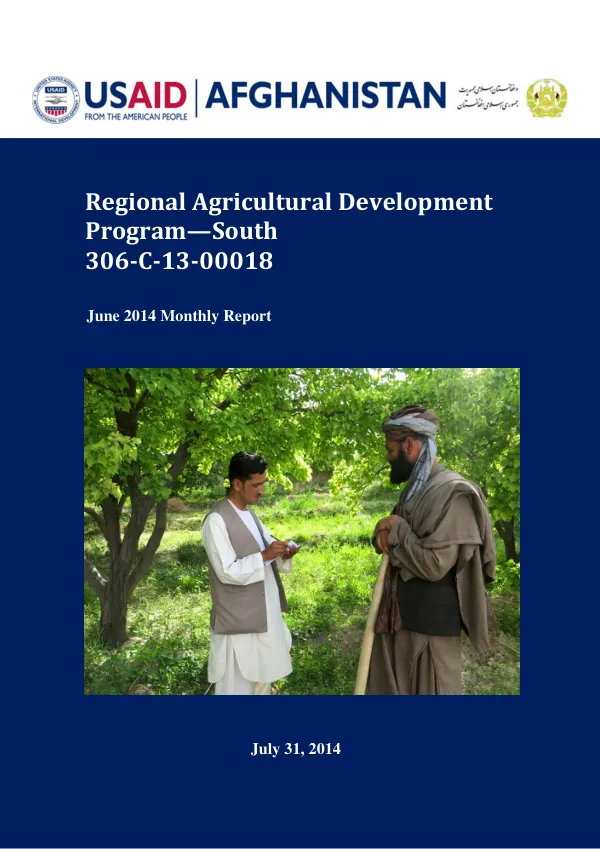
Regional Agricultural Development Program-South July 2014 Monthly Report
The Regional Agricultural Development Program-South (RADP-S) aims to improve food and economic security for rural Afghans in the provinces of Kandahar, Helmand, Zabul, and Uruzgan.
2014 · 15 pages
Sign in to readA free account is required to download.
Abstract
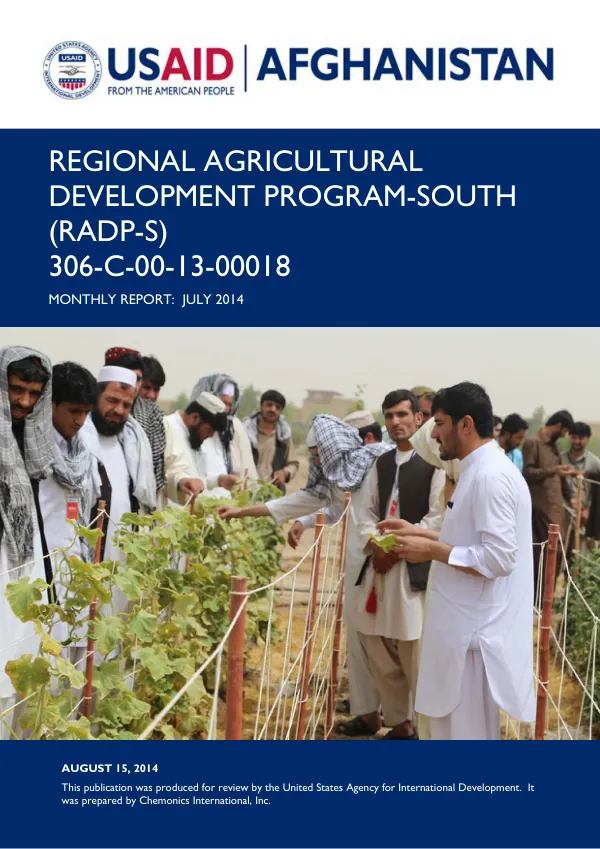
The program focuses on improving the productivity and profitability of the wheat, high value crops, and livestock value chains, while addressing policy, legal, and regulatory constraints affecting value chain development. RADP-S supports the consolidation of licit economies to fuel sustainable long-term economic growth, including providing alternatives to poppy cultivation. The implementation approach of RADP-S dovetails with Afghan and U.S. government strategies in its focus on advancing food security, regenerating agribusiness, and increasing agriculture sector jobs and incomes. RADP-S aims to strengthen the capacity of producers, associations, traders, and agribusinesses to respond to market demands; facilitate lasting market linkages between value chain actors; and support an enabling environment that allows the private sector to thrive. The program places the Afghan private sector at the forefront of implementation and addresses key cross-cutting issues of women's empowerment, agribusiness value chain facilitation, and alternative development in all facets of the program. In July 2014, RADP-S kicked off the Training of Trainers (TOT) exercises, starting with the first TOT Workshop at the AMTEX Technical Training Center. Over the course of the nine-day workshop, members of the RADP-S Productivity and Production Unit (PPU) trained 52 project master trainers in improved farming techniques, which the master trainers will transfer to lead farmers and neighboring farmers across the RADP-S target districts. The post-harvest advisor also conducted seven trainings in nutrition, food and hygiene, and harvest and post-harvest handling to the post-harvest component team, value chain facilitation unit (VCFU), and monitoring and evaluation (M&E) unit. RADP-S collaborated with each district's Directorate of Agriculture, Irrigation, and Livestock (DAIL), District Development Assembly (DDA), and local shuras (councils of village elders) to identify 174 landowners and 163 lead farmers out of the 51,520 farmers in the 15 target districts. RADP-S will select 78 lead farmers and plots of land from the list in August for the establishment of demonstration farms. Each demonstration farm will serve as a venue for building the capacity of neighboring farmers in improved productivity, production, and post-harvest practices. The RADP-S livestock component launched its six-month para-veterinary training course at the Charikar Training and Support Center in Parwan. Five technical trainers for RADP-S instructed 20 para-veterinary students and three RADP-S master trainers in subjects such as livestock anatomy and physiology, problem-based clinical diagnosis, and diagnostic and therapeutic techniques. Graduates of this course will establish 75 new veterinary field units (VFUs) across RADP-S target districts. RADP-S aims to train a total of 75 new para-veterinarians by December 2015. During the period of July 17-31, RADP-S used social mapping and analyzed district clustering to begin establishing Farmer Field Schools (FFS) in 40 villages across the ten target districts in Helmand, Zabul, and Uruzgan provinces. Each FFS will serve as the venue for RADP-S to lead participatory technology development (PTD) sessions on enhancing productivity, animal welfare, and value addition practices. To support establishment of the FFSs, RADP-S conducted a five-day training workshop in the establishment of FFSs and PTD groups to fourteen livestock extension workers, four provincial coordinators, and two provincial field coordinators. RADP-S likewise signed contracts with four veterinary field units (VFUs) in Uruzgan and used social mapping analysis to identify 27 villages for new VFU establishment. Each VFU will be responsible for providing quality veterinary services to the surrounding livestock owners and for reporting disease outbreaks to RADP-S. The RADP-S enabling environment unit (EEU) completed its analysis of the quantitative and qualitative data gleaned from 460 surveys and 14 focus groups conducted in the four target provinces during the period of March-May. The analysis identifies the most popular constraints to the wheat, high value crop, and livestock value chains, while filtering them for enabling environment relevance. In coordination with USAID and the Ministry of Agriculture, Irrigation, and Livestock (MAIL), the EEU came to an agreement to embed a long-term liaison position within the MAIL Department of Planning and Program Coordination. This will be a senior local national position that reports directly to the General Director, liaises with all RADP projects in Afghanistan, and provides subject matter expertise in the analysis and refinement of current legal and policy frameworks to support enabling environment objectives.