USAID DEC
Regional Assessment, Traditional Dispute Resolution: RC North Rule of Law Stabilization Program – Informal Component
Sign inCHECCHI AND COMPANY, CONSULTING, INC.
Regional Assessment, Traditional Dispute Resolution: RC North Rule of Law Stabilization Program – Informal Component
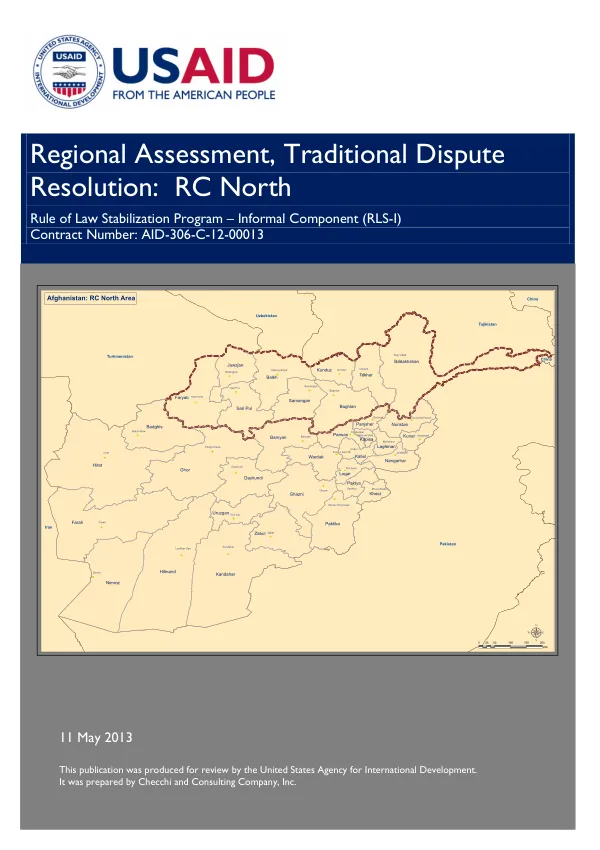
Regional Command (RC) North encompasses nine provinces in northern Afghanistan, including Badakhshan, Baghlan, Balkh, Faryab, Jawzjan, Kunduz, Samangan, Sari Pul, and Takhar.
2013 · 24 pages
Sign in to readA free account is required to download.
Abstract
The region borders the countries of Turkmenistan, Uzbekistan, and Tajikistan to the north and China and Pakistan to the east. The territory of RC North comprises an area of approximately 62,607 square miles (162,151 square kilometers), with a mix of mountainous terrain, arid plains, and fertile farmlands. The estimated current population of RC North is about 7,261,900, with a diverse ethnic composition. Tajiks and Turkic ethnic groups, such as Uzbeks and Turkmen, make up the majority of the population, while there are also pockets of large Pashtun populations living in various areas of the north. The region has experienced many political changes over the course of its history, including waves of immigration from Central Asia and programs to resettle Pashtuns from the east and south of Afghanistan to the northern provinces. Throughout most of the region, various ethnic groups have established good connections between their communities and have successfully arranged economic and political cooperation. However, within most provinces, one ethnic group has managed to capture and control, at least to some extent, large parts of the economic and political sphere. Powerbrokers play a significant role in the politics of the region and have influence down to the district and village level, often influencing traditional dispute resolution (TDR) and the formal justice sector. The regional geography and demographics have a significant impact on the economy and politics of RC North. The eastern parts of northern Afghanistan used to be home to large herds of livestock belonging to nomads of Turkic descent, but over time, with the increasing settlement of farmers in the area and the installation and expansion of irrigation canals in Kunduz and other provinces, the region shifted to agriculture and related industries. The western parts of northern Afghanistan, including Mazari Sharif, the fourth largest city in the country, have an ancient history and a rich cultural heritage. The Rule of Law Stabilization Program – Informal Component (RLS-I) conducted a series of district assessments in RC North to gain an in-depth understanding of the nature of disputes, the context surrounding those disputes, and the choices Afghans make regarding settlement of their disputes within the district. The assessments aimed to design implementation activities fulfilling RLS-I's objectives of stabilization and sustainability, including which activities should be conducted, when and where activities should be held, and which community members are best positioned to participate in the RLS-I program to help it achieve its objectives. The data collection for the TDR regional assessment encompasses the data collected for the three assessments prepared for the districts in RC North in the spring of 2012. For each district assessment, 20 individual interviews with male and female respondents and two male and two female focus group discussions were conducted. Respondents included elders involved in TDR, elected or appointed community leaders, district-level government and formal justice sector actors, local religious leaders, former jihadi commanders, current and former members of various village and district-level shuras, and teachers and headmasters. The regional assessment highlights the importance of understanding the complex relationships between various actors in the TDR process, including state actors, TDR actors, and third-party justice actors. The assessment also emphasizes the need to consider the perceptions of the formal and informal justice systems, as well as the current status of TDR and the formal-informal justice sector collaboration.