USAID DEC
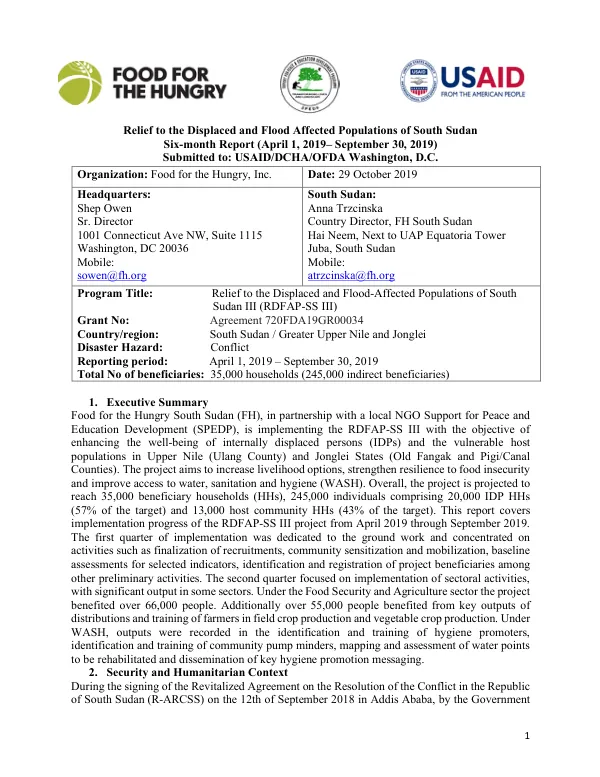
Relief to the Displaced and Flood Affected Populations of South Sudan Six-month Report (April 1, 2019– September 30, 2019)
Sign inFOOD FOR THE HUNGRY, INTERNATIONAL
Relief to the Displaced and Flood Affected Populations of South Sudan Six-month Report (April 1, 2019– September 30, 2019)
The Relief to the Displaced and Flood-Affected Populations of South Sudan project, implemented by Food for the Hungry South Sudan in partnership with Support for Peace and Education Development, aims to enhance the well-being of internally displaced persons and vulnerable host populations in Upper Nile and Jonglei States.
2019 · 11 pages
Sign in to readA free account is required to download.
Abstract
The project targets 35,000 beneficiary households, comprising 20,000 internally displaced person households and 13,000 host community households, with a total of 245,000 individuals. The project focuses on increasing livelihood options, strengthening resilience to food insecurity, and improving access to water, sanitation, and hygiene. Under the Food Security and Agriculture sector, the project benefited over 66,000 people, with more than 55,000 people receiving training in field crop production and vegetable crop production. In the WASH sector, outputs were recorded in the identification and training of hygiene promoters, community pump minders, and the mapping and assessment of water points to be rehabilitated. The security and humanitarian context in South Sudan remains fragile, with isolated cases of inter-clan clashes between youth groups. Despite the signing of the Revitalized Agreement on the Resolution of the Conflict in the Republic of South Sudan in September 2018, the peace agreement has been marred by setbacks. However, the deal has brought a level of calmness, and the number of returnees has increased, with over 209,071 refugees returning to their areas of origin since January 2019. The food security situation in South Sudan remains critical, with more than 38.8% of the population in need of food aid from September to December 2019. The Integrated Food Security Phase Classification (IPC) estimates that 19.2% of the population is in IPC Phase 4 (Emergency), 31.3% in IPC Phase 3 (Crisis), 40.4% in IPC Phase 2 (Stressed), and 20.8% in IPC Phase 1 (Minimal). In the RDFAP-SSIII operational states, the situation is more severe, with Jonglei having 52.2% of the population and Upper Nile 47.8% of the population estimated to be in IPC 3 for the period September to December 2019. The overall nutrition situation during the lean season of 2019 was critical, with a global acute malnutrition rate of 24.3% recorded in Pigi/Canal County. The IPC Acute Malnutrition August 2019 projection analysis indicates that seasonal improvement of acute malnutrition is expected during the harvest and postharvest period due to increased availability of food at the household level. However, the high prevalence of acute malnutrition experienced at the peak lean season period may not lead to a shift in phase classification but rather improvement within the same phase. Seasonal flooding in 2019 was more severe than normal, affecting an estimated 600,000 to 800,000 people through displacement and loss of personal assets, food, and livestock. Critical needs in the affected areas include access to safe drinking water, anti-malarial and other basic drugs, and plastic sheets for temporary shelters. The degradation or loss of crops and livestock and other livelihood sources will exacerbate longer-term needs and reduce food security in 2020.