MANAGEMENT SYSTEMS INTERNATIONAL
Health Care Accessing Behaviors: Religious and Ethnic Minorities (REM)
The health care seeking behavior and practices among religious and ethnic minority (REM) communities in five focus countries in the Middle East and North Africa region are explored in this report.
2021 · 34 pages
Sign in to readA free account is required to download.
Abstract
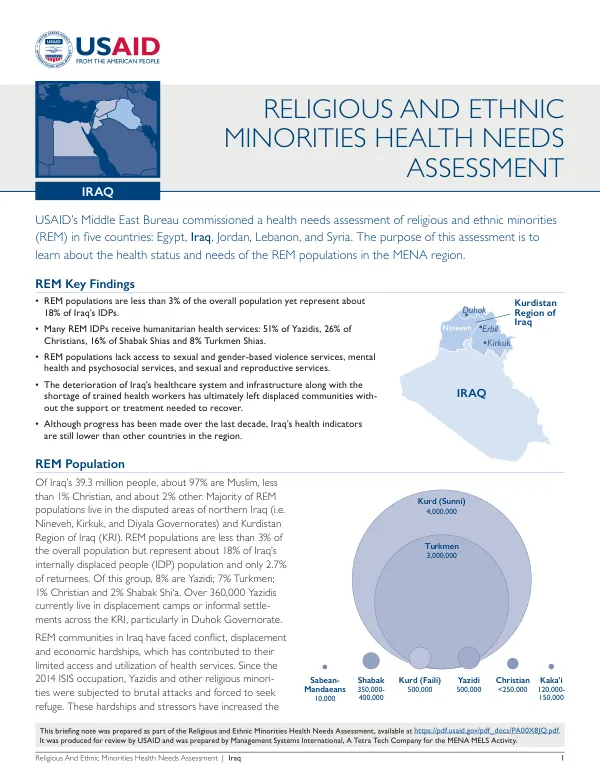
The countries of focus are Iraq, Lebanon, Syria, Jordan, and Egypt. The report provides analysis at the regional and country levels to explain similarities and specific contexts. The REM populations in these countries face significant barriers in accessing health care services. In northeast Syria, the proportion of the REM population to the national population is more than 50 percent. In Iraq, the proportion is roughly 3 percent. The region's years of conflict have caused mass displacements, both internally and externally, and have disproportionately affected some REM communities. The report highlights the challenges faced by REM populations in accessing health care services. Refugees and internally displaced persons (IDPs) in all five countries are more vulnerable than the rest of the population due to poor health outcomes, high poverty levels, inadequate living conditions, and lack of access to health care services. The COVID-19 pandemic has negatively affected broader health issues among vulnerable populations, leading to an increase in sexual and gender-based violence (SGBV) across the region. The report also notes that inadequate funding and investment in health systems have affected the growth, quality, and coverage of health services in the region. Disparities in health indicators related to geographic location, gender, and nationality are evident. While Iraq, Jordan, and Egypt have made progress in improving their populations' overall health over the past decade, significant disparities remain. The report identifies key barriers to accessing health services, including poverty levels, inadequate living conditions, and lack of access to health care services. The report also highlights the need for mental health and psychosocial support services, particularly for survivors of SGBV and those exposed to conflict. The report provides recommendations for reaching REM populations more effectively through USAID health programming. These recommendations include addressing the specific needs of REM populations, improving access to health care services, and increasing funding and investment in health systems. The report also notes that the region's health systems face significant challenges, including inadequate funding, poor infrastructure, and a shortage of skilled health workers. The report highlights the need for a comprehensive approach to addressing the health needs of REM populations, including improving access to health care services, increasing funding and investment in health systems, and addressing the specific needs of REM populations. The report concludes that addressing the health needs of REM populations requires a comprehensive approach that takes into account the specific challenges and barriers faced by these populations. The report provides recommendations for USAID health programming to address these challenges and improve access to health care services for REM populations.
Related documents