MANAGEMENT SYSTEMS INTERNATIONAL
Religious and Ethnic Minority Health Needs Assessment Briefing Note: Syria
The health needs of religious and ethnic minorities (REM) in Syria are a pressing concern.
2021 · 3 pages
Sign in to readA free account is required to download.
Abstract
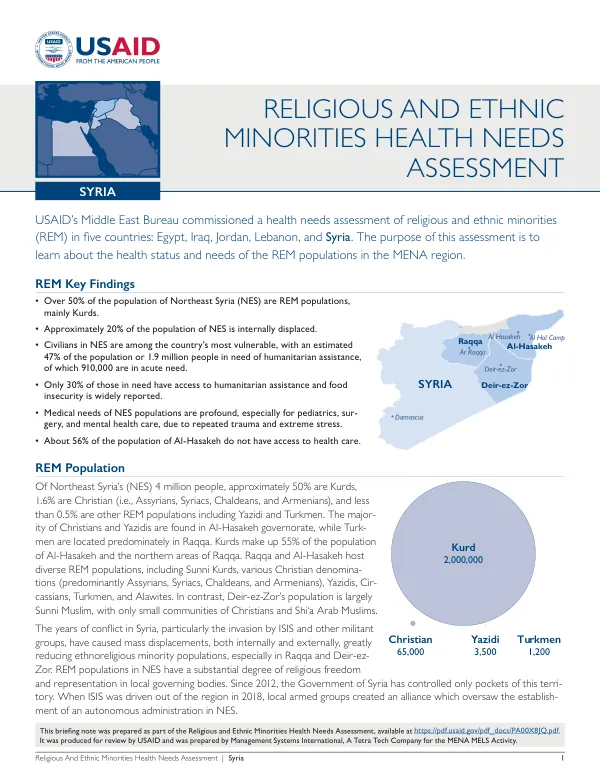
Northeast Syria (NES) is home to approximately 50% of the country's REM population, with Kurds making up the largest group, followed by Christians and Yazidis. The region has been plagued by conflict, displacement, and economic challenges, resulting in a significant humanitarian crisis. The population of NES is highly vulnerable, with an estimated 1.9 million people in need of humanitarian assistance, of which 910,000 are in acute need. Only 30% of communities assessed throughout the three NES governorates could access humanitarian assistance, and 71% of communities with access reported inadequate assistance. The lowest levels of humanitarian assistance were reported in Deir-ez-Zor. The health system in NES is severely challenged, with many health facilities damaged or destroyed, and transportation of essential aid impeded. It is estimated that more people have died from lack of access to food, health care, and medicine than directly from violence. Chronic diseases are the most commonly reported health problem, and the associated treatment is the most commonly reported health need. The lack of a health workforce is a significant issue, with roughly 70% of Syria's health workers having left the country as migrants or refugees due to the ongoing crisis. As of early 2020, there were only 3.5 physicians per 10,000 people in NES. Reports also indicate that medical personnel have been targeted by armed actors in the region. The lack of health facilities is another major challenge, with only 6% of public hospitals in NES operating at full capacity, while 44% are not operating, and 50% are operating at partial capacity. Of the 279 primary health centers in NES, less than 2% are functioning at full capacity, and only 8% at partial capacity, creating extreme challenges for the 1.8 million people in need of health assistance in NES. Mental health is a significant concern, with an estimated 56% of the population of NES in need of psychosocial support and 43% in need of psychological first aid. As of April 2020, only 9% of the sub-districts in NES provided some psychosocial services, with the remaining sub-districts providing no services. The population of NES relies heavily on humanitarian assistance, including health services, due to the lack of resources and capacity of the health care system in NES coupled with the economic collapse inside Syria. Access in NES and the delivery of essential medical and pharmaceutical supplies is often interrupted by the closure of border crossings and the unstable security situation in the region. Key health indicators in NES include high rates of malnutrition and poor health, with approximately 83% of the population reporting health problems associated with chronic diseases in 2020. Trauma-related disabilities are also a significant concern, with an estimated 10.2 million Syrians at risk of being injured by explosive hazards. Maternal and child health indicators are also alarming, with a maternal mortality ratio in Syria that has increased by 40% since the start of the conflict in 2011. The humanitarian crisis in NES is further exacerbated by the presence of Turkish-backed armed groups, which has caused another wave of displacements, affecting the remaining Christian groups. Areas within Al-Hasakeh have received the most significant numbers of displaced people, including REM populations displaced from other regions within NES. Members of REM communities in these areas believe that gradual emigration of their populations will continue due to the region's instability and economic challenges.