USAID DEC
Renewable Energy Zone (REZ) Transmission Planning Process: A Guidebook for Practitioners
Sign inU.S. NATIONAL RENEWABLE ENERGY LABORATORY
Renewable Energy Zone (REZ) Transmission Planning Process: A Guidebook for Practitioners
The Renewable Energy Zone (REZ) transmission planning process is a guidebook for practitioners developed by Nathan Lee, Francisco Flores-Espino, and David Hurlbut at the National Renewable Energy Laboratory.
2017 · 28 pages
Sign in to readA free account is required to download.
Abstract
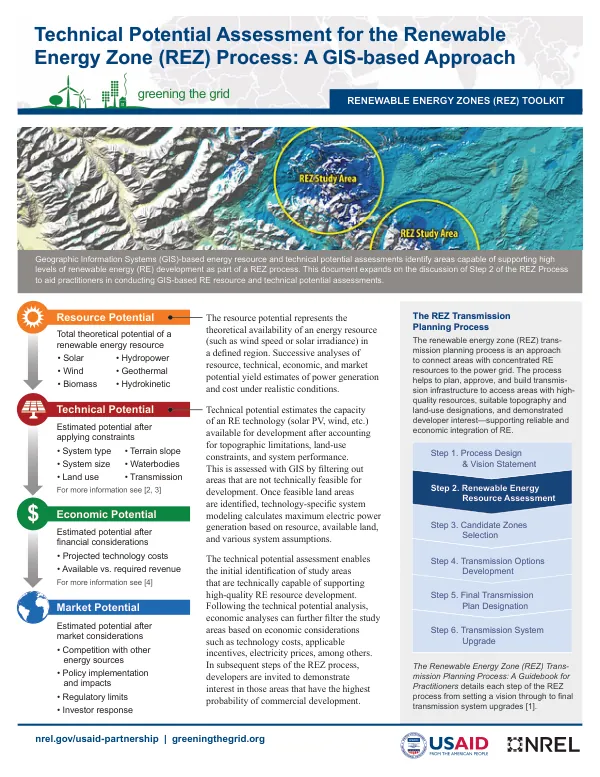
The REZ process is designed to help policymakers ensure their infrastructure investments achieve national goals in the most economical manner. A REZ is a geographic area that enables the development of profitable and cost-effective grid-connected renewable energy. A REZ has high-quality renewable energy resources, suitable topography and land-use designations, and demonstrated interest from developers, all of which support cost-effective renewable energy development. The REZ transmission planning process is an approach to plan, approve, and build transmission infrastructure that connects REZs to the power system. The REZ process focuses on large-scale wind and solar resources that can be developed in sufficient quantities to warrant transmission system expansion and upgrades. These variable renewable energy resources are similar to large hydropower in that transmission systems must be brought to the location of the resource to connect them to the grid. The REZ process may not be applicable in situations in which other reasons limit renewable energy development, or if the existing transmission system already has capacity to accommodate new renewable energy development. The REZ process involves several steps, including process design and vision statement, renewable energy resource assessment, and transmission planning. The process design and vision statement involve identifying the scope of the REZ process, developing a vision statement, and establishing a detailed process design. The renewable energy resource assessment involves conducting technical potential analysis, producing renewable energy resource maps, and excluding areas not available for development. The technical potential analysis involves evaluating the technical potential of renewable energy resources in a given area. This includes assessing the availability of wind and solar resources, as well as other renewable energy resources such as geothermal and hydroelectric power. The renewable energy resource maps are used to identify areas with high potential for renewable energy development. The REZ process is necessary because traditional transmission planning may be ill-suited to the characteristics of renewable energy development. Transmission planning decisions need to be made well in advance of renewable generation development decisions, and wind and solar power need to be located in windy and sunny areas that are sometimes far from large load centers. The REZ process helps to increase the share of solar, wind, and other renewable energy resources in the power system while maintaining reliability and economics. The REZ process has been used in various parts of the world, including Texas, where it was used to develop the Competitive Renewable Energy Zones (CREZ) process. The CREZ process was used to identify areas with high potential for renewable energy development and to develop transmission infrastructure to connect these areas to the power system. The REZ process is a valuable tool for policymakers and planners seeking to integrate renewable energy into their power systems while maintaining reliability and economics.