USAID DEC
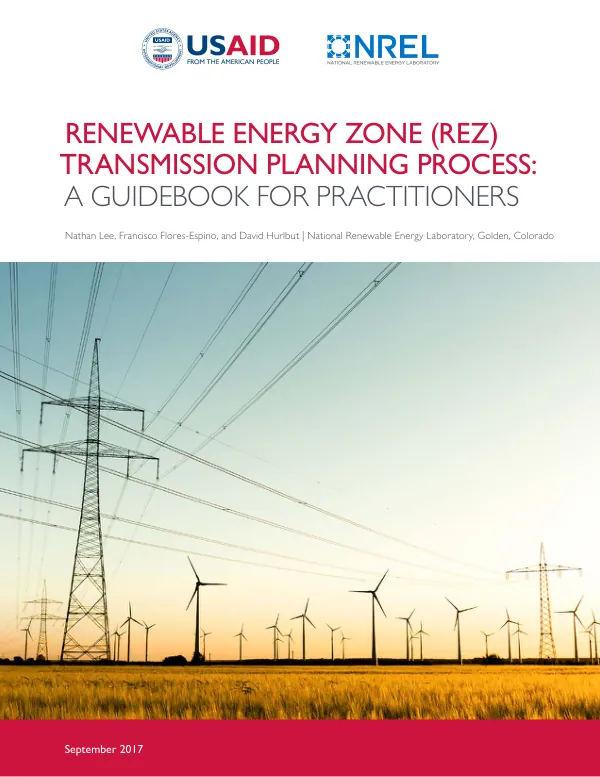
Technical Potential Assessment for the Renewable Energy Zone (REZ) Process: A GIS-based Approach
Sign inU.S. NATIONAL RENEWABLE ENERGY LABORATORY
Technical Potential Assessment for the Renewable Energy Zone (REZ) Process: A GIS-based Approach
The renewable energy zone (REZ) transmission planning process is an approach to connect areas with concentrated renewable energy resources to the power grid.
2018 · 2 pages
Sign in to readA free account is required to download.
Abstract
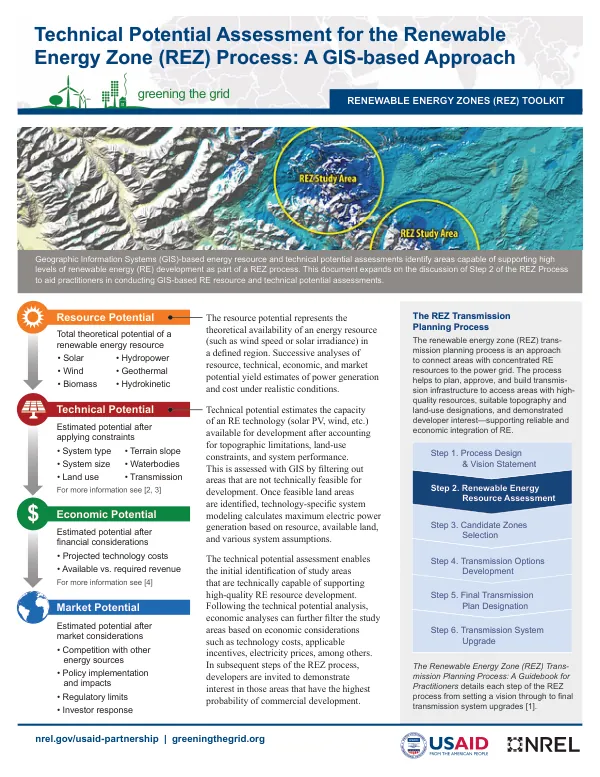
This process helps plan, approve, and build transmission infrastructure to access areas with high-quality resources, suitable topography, and land-use designations, and demonstrated developer interest. The process supports reliable and economic integration of renewable energy. The REZ transmission planning process involves several steps, including setting a vision, conducting a technical potential assessment, and selecting candidate zones. The technical potential assessment is a critical component of the REZ process, which estimates the capacity of renewable energy technologies available for development after accounting for topographic limitations, land-use constraints, and system performance. This assessment is conducted using Geographic Information Systems (GIS) by filtering out areas that are not technically feasible for development. The technical potential assessment enables the initial identification of study areas that are technically capable of supporting high-quality renewable energy resource development. Following the technical potential analysis, economic analyses can further filter the study areas based on economic considerations such as technology costs, applicable incentives, electricity prices, and investor response. In subsequent steps of the REZ process, developers are invited to demonstrate interest in those areas that have the highest probability of commercial development. The REZ process involves the analysis of various factors, including resource potential, technical potential, economic potential, and market potential. Resource potential represents the theoretical availability of an energy resource in a defined region. Technical potential estimates the capacity of an RE technology available for development after accounting for topographic limitations, land-use constraints, and system performance. Economic potential estimates the potential after financial considerations, including projected technology costs and available revenue. Market potential estimates the potential after market considerations, including competition with other energy sources, policy implementation, and regulatory limits. The REZ transmission planning process is supported by the U.S. Agency for International Development (USAID) and the National Renewable Energy Laboratory (NREL). The REZ Toolkit is a collection of resources to help power system planners, developers, key decision makers, and stakeholders understand and use the REZ transmission planning process to integrate transmission expansion planning and renewable energy generation planning. The REZ Toolkit is part of the Greening the Grid technical platform, which addresses the technical challenges around grid modernization and state-of-the-art practices in bringing advanced energy technologies into the power sector. The REZ process involves several key steps, including identifying constraints and collecting data, conducting technical potential analyses, and performing further analysis and mapping. The technical potential analysis identifies study areas that could support high levels of renewable energy development. In the next steps, economic analyses can help to further filter the study areas based on economic considerations such as the cost of generation. The REZ process ultimately aims to support the reliable and economic integration of renewable energy into the power grid.