USAID DEC
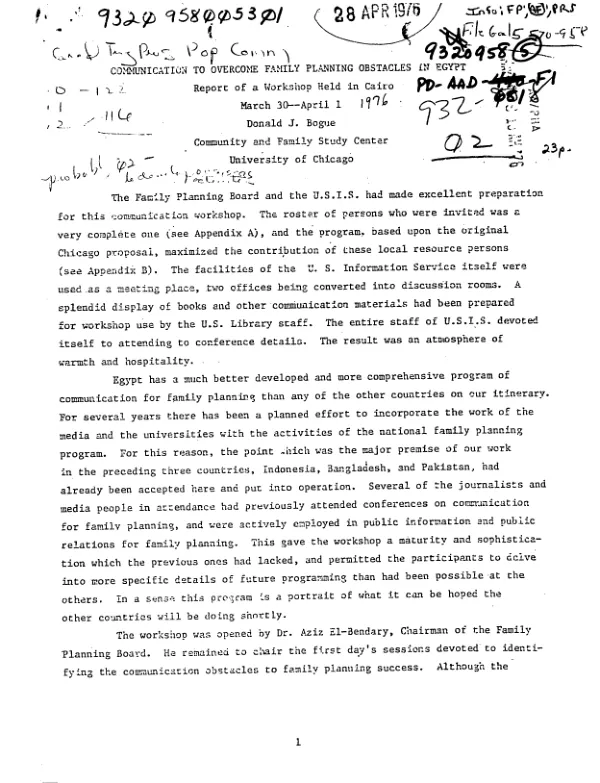
Report of a Workshop Held in Cairo: It's COM'rNNICATION TO OVERCOME FAMILY PL.MNNING OBSTACLES £N EGYPT
Sign inNORC AT THE UNIVERSITY OF CHICAGO
Report of a Workshop Held in Cairo: It's COM'rNNICATION TO OVERCOME FAMILY PL.MNNING OBSTACLES £N EGYPT
The communication to overcome family planning obstacles in Egypt was the focus of a workshop held in Cairo from March 3 to April 1.
2010 · 23 pages
Sign in to readA free account is required to download.
Abstract
The workshop was organized by the Family Planning Board and the U.S. Information Service, with the support of the University of Chicago's Community and Family Study Center. The event brought together a diverse group of participants, including local resource persons, journalists, and media representatives. The workshop aimed to identify and address the communication obstacles to family planning success in Egypt. The participants were divided into four discussion groups, each focusing on a specific obstacle. The first obstacle selected was the neglect of environmental protection, national economic development, and community welfare as motives for family planning. The participants recognized that population growth is outstripping the environmental resources added by modernization programs, and that these broad socio-economic changes must be brought into the consciousness of the citizenry. The second obstacle identified was the lack of awareness of family planning services available in Egypt. The participants noted that present health workers are not being sufficiently encouraged to spread the word about family planning services, and that not enough mass media time is devoted to the practical aspects of where to go, what times the services are available, and what it costs. The media should start to criticize irregular services and bring pressure to bear on negligent centers to shape up. The third obstacle selected was the fears about the effects of the pill and IUD. The participants recognized that the various field workers and clinic workers are not themselves well-informed about the truth of the side effects, and that they need to be re-educated. The national family planning program is not aggressive enough in responding to published newspaper and other reports about side effects, and the press is required to publish news items that may be damaging to the reputation of particular methods. The fourth obstacle identified was illiteracy as a barrier to effective family planning communication. The participants recognized that illiteracy is a tremendous barrier that obstructs and determines all IEC efforts in Egypt. They proposed that an active IEC effort should try to use village religious leaders and religious meetings as opportunities to discuss the population problem. The workshop participants developed specific solutions for each of the four obstacles. For the first obstacle, they proposed emphasizing national, environmental problems more, and involving local village leaders in the discussion. For the second obstacle, they suggested that present health workers should be encouraged to spread the word about family planning services, and that not enough mass media time is devoted to the practical aspects of where to go, what times the services are available, and what it costs. For the third obstacle, they proposed that the various field workers and clinic workers should be re-educated about the truth of the side effects, and that the national family planning program should be more aggressive in responding to published newspaper and other reports about side effects. For the fourth obstacle, they suggested that an active IEC effort should try to use village religious leaders and religious meetings as opportunities to discuss the population problem. The workshop participants also discussed how to make presentations more interesting and persuasive by representatives of the press and television. They proposed that the suggestions be incorporated into both movies and television programming for family planning in Egypt. The workshop was a success, and the participants were able to develop specific solutions for each of the four obstacles.