USAID DEC
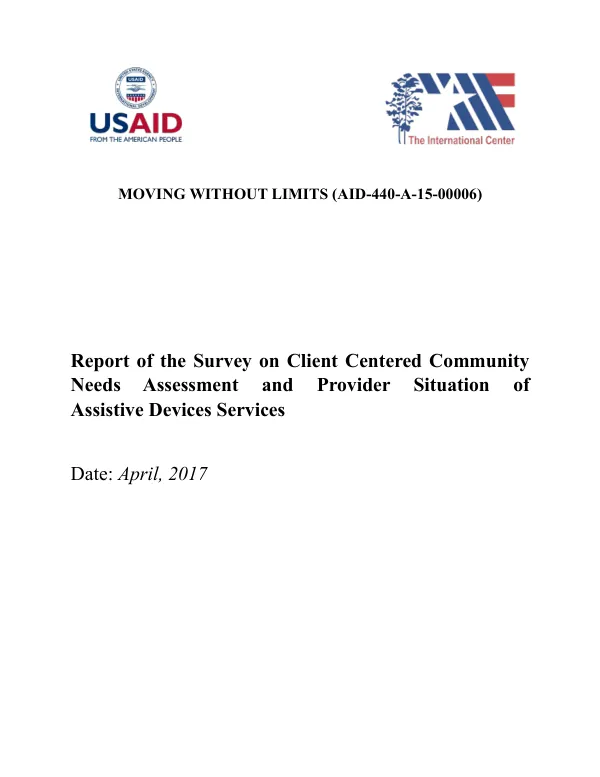
Report of the Survey on Client Centered Community Needs Assessment and Provider Situation of Assistive Devices Services
Sign inUSAID
Report of the Survey on Client Centered Community Needs Assessment and Provider Situation of Assistive Devices Services
The "Moving without Limits" project, implemented by The International Center in partnership with USAID, aims to improve accessibility for people with mobility impairments in Thua Thien Hue, Quang Nam, and Binh Dinh provinces.
2017 · 60 pages
Sign in to readA free account is required to download.
Abstract
The project focuses on increasing the availability and accessibility of assistive devices in the region. Three specific objectives of the project include improving the availability of quality assistive devices, improving the capacity of service providers and people with disabilities on assistive devices, and increasing community access to information on assistive devices. A survey was conducted to identify the practice on activity of daily living (ADL) related assistive device (AD) provision in Vietnam. The survey aimed to map specific potential health facilities and device facilities across six areas of Vietnam, including Danang, Quang Nam, Ho Chi Minh City, Binh Dinh, and Hue. The survey also aimed to identify the current accessibility of AD in each region visited during the field trip and produce recommendations regarding AD-specific, sustainable service models in partnership with existing local services, manufacturers, and human resources. The survey involved a mixed purposeful sampling strategy, with participants selected from people with disabilities (PWDs), health professionals, manufacturing companies, and retailers. Data collection was undertaken in various locations, including PWDs' homes, public health facilities, manufacturing factories, and local markets. The data were collected via recorder and live transcription, with interviews conducted by the consultant with the assistance of two research assistants. The analysis of the data focused on examining and documenting the individual functional difficulties of PWDs, categorized by classifications of the Washington questions, and the associated need for assistive devices within each region. The capacity of each province to produce assistive devices was also examined. Consultation with PWDs and their families involved key informant interviews, which collected demographic details, information related to PWDs' knowledge and access to current available AD services, and their level of health insurance. Consultation with Department of Health officials and healthcare professionals involved key informant interviews and focus groups, which aimed to gather information related to the incidence and prevalence of local disability trends, workforce data, and the reported efficiency and effectiveness of current services. The survey results showed that PWDs in the region face significant challenges in accessing assistive devices, including limited availability and high costs. The survey identified several facilitating factors that can support workshop development, including the availability of local materials and the potential for revenue generation through health insurance funds. However, the survey also identified several PWD-related factors that may influence the utilization of ADs, including socio-economic status and behaviors. The survey recommended several methods of capacity building in provinces to ensure quality and sustainability, including training for healthcare professionals and the establishment of local production workshops. The survey results have implications for the development of assistive device services in Vietnam, highlighting the need for increased accessibility and affordability of ADs, as well as the importance of community-based initiatives to support PWDs. The survey's findings and recommendations can inform the development of sustainable service models that meet the needs of PWDs in the region.