USAID DEC
Report on Advocatura
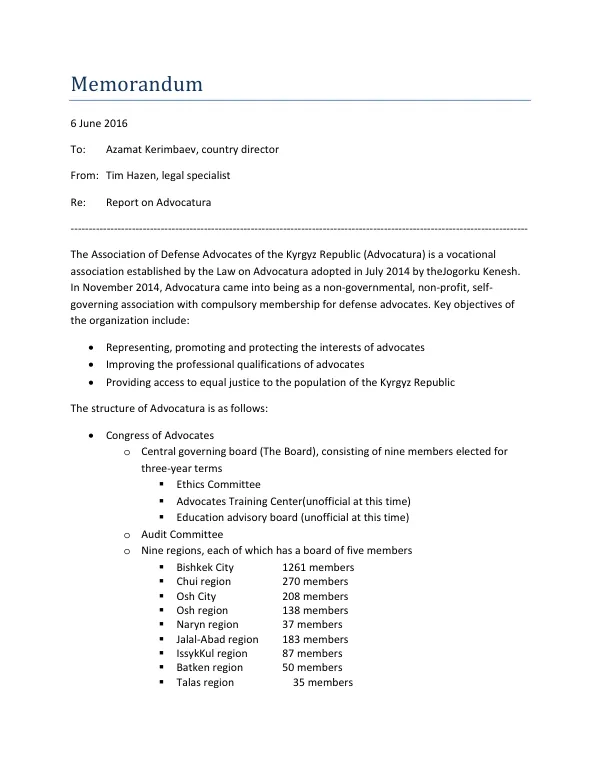
The Association of Defense Advocates of the Kyrgyz Republic, known as Advocatura, is a vocational association established by the Law on Advocatura adopted in July 2014 by the Jogorku Kenesh.
2016 · 17 pages
Sign in to readA free account is required to download.
Abstract
Advocatura came into being as a non-governmental, non-profit, self-governing association with compulsory membership for defense advocates in November 2014. The organization's key objectives include representing, promoting, and protecting the interests of advocates, improving the professional qualifications of advocates, and providing access to equal justice to the population of the Kyrgyz Republic. The structure of Advocatura consists of a Congress of Advocates, which is the supreme governing body of the organization. The Congress is composed of nine members elected for three-year terms, who form the Central governing board, also known as The Board. The Board is responsible for overseeing the activities of Advocatura and is divided into several committees, including the Ethics Committee, Advocates Training Center, and Education advisory board. Advocatura is also divided into nine regions, each with its own board of five members. The First Congress of Advocatura was held in November 2014, during which statutory documents were approved, and fee levels were established. The entrance fee was set at 2000 KGS, and monthly dues were set at 200 KGS. In March 2016, an Extraordinary Congress was held, during which the entrance fee was increased to 20000 KGS, and it was mandated that each region would collect monthly dues from its members, with 90% of the dues retained by the region and 10% remitted to The Board. Advocatura faces several challenges, including sustainability, as it is a new organization and a new concept in the Kyrgyz Republic. The mandatory bar aspect of Advocatura may present difficulties, as some members may resent being forced to join and pay fees. Financial sustainability is also a critical challenge, as Advocatura relies heavily on international donor support. The organization needs to build trust with its members and become financially sustainable over the longer-term. To address these challenges, Advocatura needs to increase revenue from within and rely less on donor support. One way to increase revenue is to raise dues. Projections show that a 50% dues increase to 300 KGS per month would likely result in positive net revenue for the years 2018-2020, although the margins are very small and would provide an insufficient cushion should unexpected expenses occur. Advocatura also needs to adopt a policy of financial transparency, which involves proactively disseminating clear and understandable reports at regular junctures, like the board meetings and the Congress, and providing interested members with access to these financial reports when requested. Advocatura's income and expense projections indicate that the organization will likely end the year 2016 in the black, but without significant continuing donor support, projections of revenue and expenses indicate that Advocatura will probably not generate sufficient revenue to break even in 2017 and in following years. The organization will need to find increased sources of revenue from within and rely less on donor support to become financially sustainable over the longer-term.