USAID DEC
Report to the Congress: The Brazilian Economic Boom: How Should the United States Relate to It?
Sign inINTERNATIONAL PEACE CORPS
Report to the Congress: The Brazilian Economic Boom: How Should the United States Relate to It?
The Brazilian Economic Boom: How Should the United States Relate to It?
94 pages
Sign in to readA free account is required to download.
Abstract
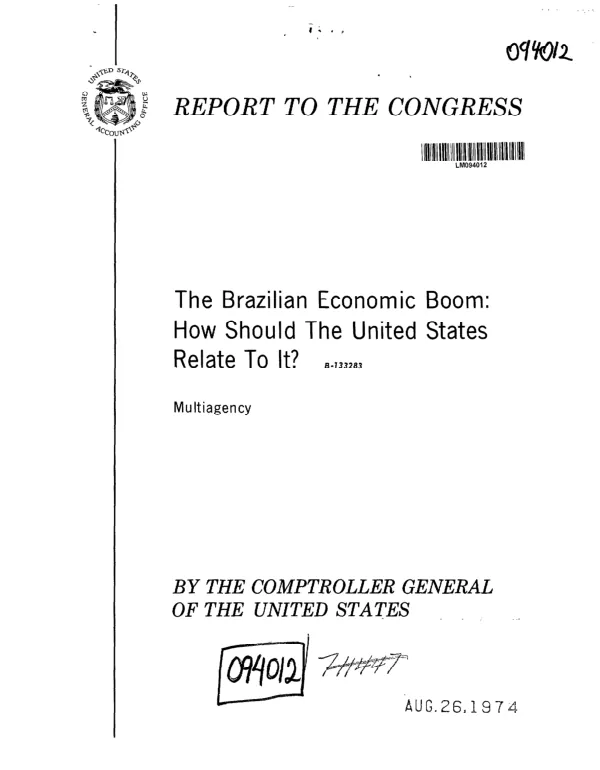
is a report to the Congress by the Comptroller General of the United States. The report examines the administration of U.S. Government activities in Brazil, with a focus on the country's economic development and the role of the United States in this process. Since 1962, the United States has provided Brazil with over $4.3 billion in assistance through bilateral and multilateral programs. The Agency for International Development (AID) has been the principal U.S. assistance agency, making about $1.5 billion in loans and grants. However, the report notes that economic aid has declined since its peak year of 1966, and the Department of State and AID recognize Brazil's reduced need for this type of assistance. The report recommends that the Department of State and AID act to end this assistance as expeditiously as possible. Additionally, State should shift monitoring responsibilities for uncompleted AID projects to Brazilian Government agencies and reduce AID staff until AID can be phased out completely. The report also examines the Brazilian economy, which began stabilizing in 1968 and achieved a high sustained growth rate by 1970. As a result, the report recommends that State and AID try to renegotiate the terms of AID concessional loans to accelerate loan repayments or increase the interest rates to cover the U.S. Government cost for servicing these loans. The report also discusses military assistance, noting that the United States provided over $200 million in equipment and materiel to Brazil through the military assistance grant-aid program. However, due to the age of this equipment and the lack of monitoring by U.S. military representatives in Brazil, the report recommends that the United States consider liquidating its reversionary rights to such equipment. The report also examines the Peace Corps, noting that its effectiveness was hampered by key management positions being vacant for extended periods of time. Additionally, the Corps' shift in emphasis from grass roots programs to those requiring highly technical and professional skills for assignments in major urban centers in Brazil have created problems in volunteers' morale and in obtaining adequate technical staff. The report also discusses the U.S. Information Agency, noting that it has acted to improve management of Brazilian operations, responding to changing conditions by adapting its objectives, target audiences, and management operations to meet changing events. However, the report notes that the Agency still has not devised adequate research methods for measuring the effects of its various activities on foreign audiences or the net results of information programs. Finally, the report examines trade and commerce, noting that U.S. total trade with Brazil is increasing, but our relative share of Brazil's market is declining. The report recommends that the Department of Commerce needs to review its market research activities in Brazil to improve them, and consider establishing a U.S. trade center in Sao Paulo, Brazil's economic and industrial heartland, to encourage buying of U.S. industrial and commercial items and technology. Overall, the report concludes that major U.S.-stated objectives are being met in Brazil, with Brazil's economic development progressing rapidly. However, the report notes that there are still some problems and improvements needed, and that the United States should continue to adapt its policies and programs to meet changing conditions in Brazil.