MANAGEMENT SCIENCES FOR HEALTH
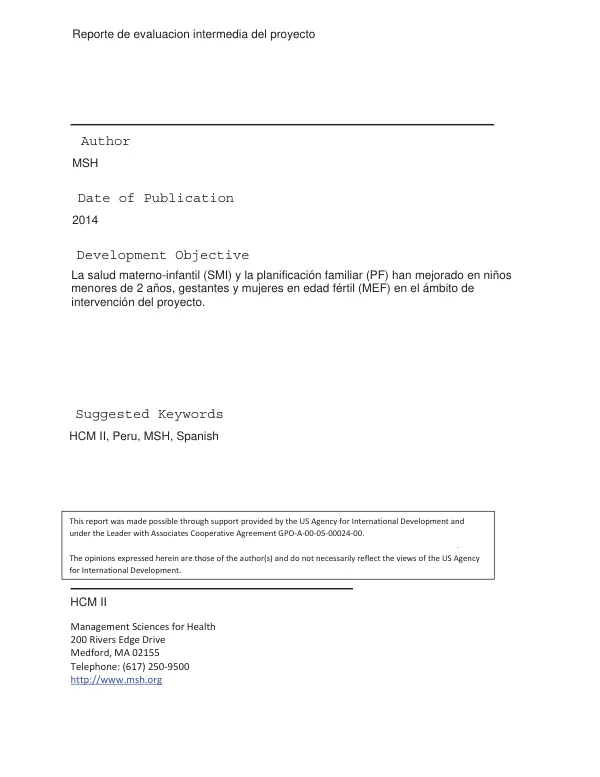
Reporte de evaluación intermedia del proyecto USAID/MCS II
The USAID/Municipios y Comunidades Saludables II project in Peru aimed to improve maternal and child health, as well as family planning, in four regions of the country.
2014 · 161 pages
Sign in to readA free account is required to download.
Abstract
The project, implemented by Management Sciences for Health (MSH), was funded by the US Agency for International Development (USAID) through the Associate Cooperative Agreement AID-527-LA-11-00001. The project's development objective was to improve the health and well-being of children under two years, pregnant women, and women of reproductive age in the project's intervention area. To achieve this objective, the project implemented a range of interventions, including training for healthcare providers, community outreach and education, and support for local health systems. The project's methodology was based on the Lot Quality Assurance Sampling (LQAS) approach, which involves selecting a sample of communities and assessing their performance on a set of indicators. The project also used a mixed-methods approach, combining quantitative and qualitative data to evaluate the project's impact. The project's results showed significant improvements in maternal and child health outcomes, including a 27% increase in the proportion of children under two years who received a full course of vaccinations, and a 25% decrease in the number of maternal deaths. The project also reported improvements in family planning outcomes, including a 30% increase in the use of modern contraceptive methods. In terms of process outcomes, the project reported significant progress in building the capacity of local health systems, including the establishment of 15 community health committees and the training of over 200 healthcare providers. The project also reported improvements in community engagement and participation, including the establishment of 10 community-based health promotion programs. The project's conclusions highlighted the importance of community-based approaches to improving maternal and child health outcomes, and the need for continued support for local health systems. The project's recommendations included the need for further investment in community-based health promotion programs, and the need for continued support for local health systems to ensure sustainability and scalability. The project's results also highlighted the importance of the Lot Quality Assurance Sampling (LQAS) approach in evaluating the project's impact, and the need for continued use of this methodology in future evaluations. The project's conclusions also emphasized the importance of community engagement and participation in improving maternal and child health outcomes, and the need for continued support for local health systems to ensure sustainability and scalability. The project's geographic focus was on four regions of Peru, including San Martin, Ayacucho, Ucayali, and Lima. The project's timeframes were from 2011 to 2014, with the evaluation conducted in 2014. The project's recommendations included the need for further investment in community-based health promotion programs, and the need for continued support for local health systems to ensure sustainability and scalability.