USAID DEC
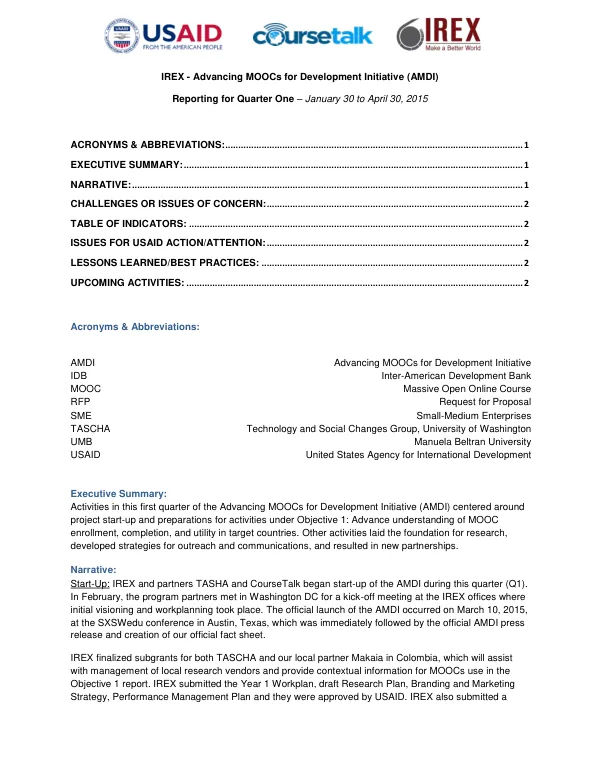
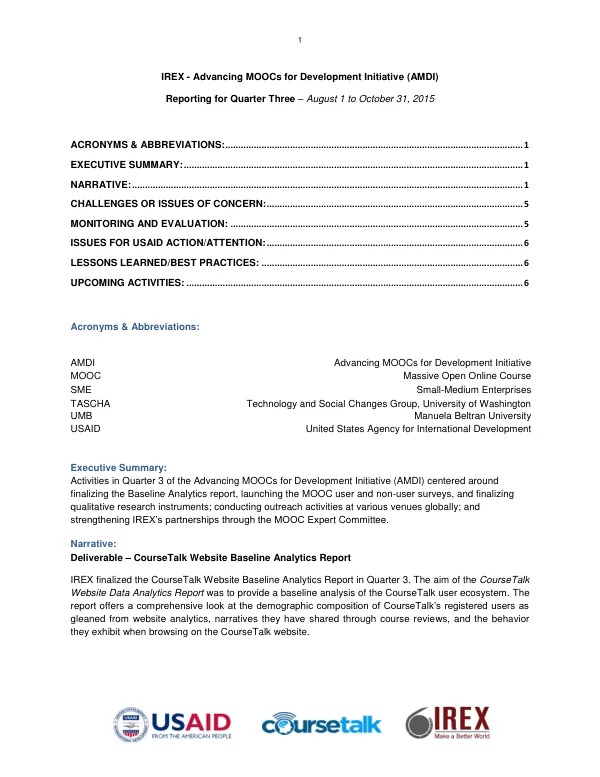
Reporting for Quarter Three – August 1 to October 31, 2015: Advancing MOOCs for Development Initiative (AMDI)
Sign inFHI 360
Reporting for Quarter Three – August 1 to October 31, 2015: Advancing MOOCs for Development Initiative (AMDI)
The Advancing MOOCs for Development Initiative (AMDI) is a program aimed at promoting the use of Massive Open Online Courses (MOOCs) in developing economies.
2015 · 7 pages
Sign in to readA free account is required to download.
Abstract
The initiative is led by IREX, in partnership with the Technology and Social Changes Group (TASCHA) at the University of Washington, and is funded by the United States Agency for International Development (USAID). The AMDI program focuses on three key areas: improving the reach and accessibility of MOOCs, enhancing the quality and relevance of MOOC content, and fostering a community of practice among MOOC users and developers. To achieve these goals, the program conducts research and analysis, develops and implements new technologies and tools, and engages with key stakeholders and partners. One of the key deliverables of the AMDI program is the CourseTalk Website Baseline Analytics Report, which provides a comprehensive analysis of the demographic composition of CourseTalk's registered users. The report identifies key search terms related to workforce development issues in emerging economies and provides recommendations for improving website analytic data. The report also highlights the importance of reviewer engagement, social media integration, and data analytics capabilities in reaching MOOC users in developing economies. In addition to the CourseTalk report, the AMDI program has also finalized the user and non-user surveys, which were launched on September 2nd in both Spanish and English. The surveys aim to gather data on MOOC users and potential users in developing economies, with a focus on understanding their needs, preferences, and behaviors. As of November 6th, the survey has received a response rate of 45% in Colombia, 47% in the Philippines, and 35% in South Africa. IREX has also engaged with key stakeholders and MOOC users during a number of events in Quarter 3, including the Technology Salon in Bangkok, Thailand, and the mEducation Alliance Symposium in Washington DC. These events aimed to increase AMDI's visibility and raise awareness of MOOCs in non-traditional user groups. The AMDI program has also partnered with local research partners to conduct key informant interviews with government stakeholders, higher education officials, and top industry employers. These interviews will be conducted in November and December of Quarter 4 and aim to gather insights on the potential of MOOCs in developing economies. Overall, the AMDI program is making significant progress in promoting the use of MOOCs in developing economies. The program's research and analysis, technological innovations, and stakeholder engagement are all contributing to a better understanding of the potential of MOOCs and the development of effective strategies for their implementation. The program's focus on improving the reach and accessibility of MOOCs, enhancing the quality and relevance of MOOC content, and fostering a community of practice among MOOC users and developers is critical to achieving its goals. By working with key stakeholders and partners, the AMDI program is well-positioned to make a meaningful impact in the field of MOOCs and contribute to the development of more effective and sustainable education solutions in developing economies. IREX's partnerships with local research partners and key stakeholders are also critical to the program's success. These partnerships enable the program to gather insights and feedback from a diverse range of stakeholders, which is essential for developing effective and sustainable education solutions. The AMDI program's use of technology, including the Open Data Kit platform and tablets, is also noteworthy. These technologies have the potential to improve the efficiency and effectiveness of data collection and analysis, and to facilitate cloud-based data access.
Related documents