USAID DEC
Research Brief: Highlights from Formative Research with First-Time Young Parents in Cross River State, South Nigeria
Sign inUSAID
Research Brief: Highlights from Formative Research with First-Time Young Parents in Cross River State, South Nigeria
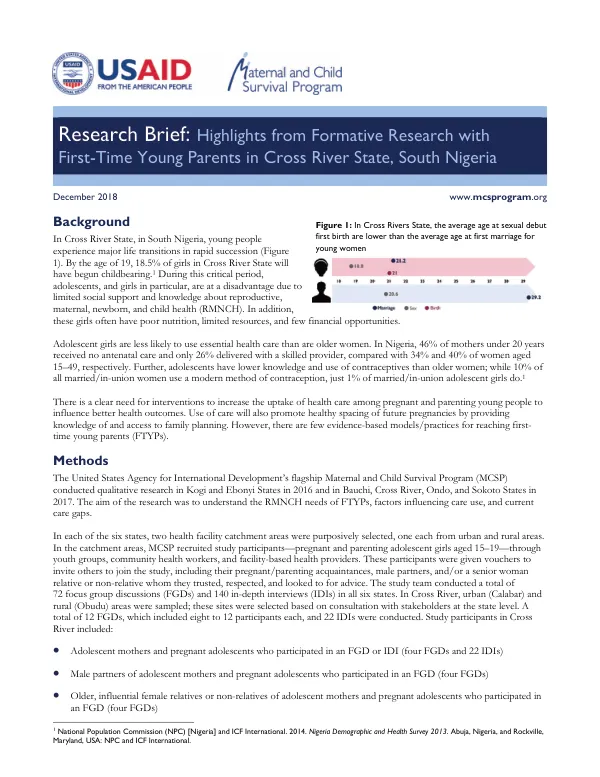
The Maternal and Child Survival Program (MCSP) conducted formative research in Cross River State, South Nigeria, to understand the reproductive, maternal, newborn, and child health (RMNCH) needs of first-time young parents (FTYPs).
2018 · 4 pages
Sign in to readA free account is required to download.
Abstract
The research aimed to identify factors influencing care use and current care gaps among FTYPs. The study was conducted in two health facility catchment areas, one in urban and one in rural areas, in Cross River State. A total of 72 focus group discussions (FGDs) and 140 in-depth interviews (IDIs) were conducted with pregnant and parenting adolescent girls aged 15-19, their male partners, and older female relatives or non-relatives. The study participants were recruited through youth groups, community health workers, and facility-based health providers. The research found that FTYPs felt that health care was important, but they did not often use it due to various barriers. The most important barriers to care were the financial burden of care, influence of individuals with power over FTYPs' decision-making, and health care that does not respond to the needs of adolescents. In Cross River State, specific findings included adolescents' experiences with pregnancy and parenthood, individuals who most influence FTYPs' use of health care, and factors that facilitate use of health care. Adolescents' experiences with pregnancy and parenthood varied, with some feeling ashamed and others being happy and excited. Marriage mediated reactions to adolescent parenthood, with people being happy if the FTYP couple was married and negative if not. Older female relatives were identified as a greater barrier to care use than partners, who were considered responsible for their wives' care. Good experiences with care and perception of need for health care were the most commonly mentioned health system-related facilitators of care use. Participants expressed that delivering in a health facility is safer for both mother and child, and that health facilities educate people. Adolescents and their influencers desire to space pregnancies, with the ideal period varying from 2 to 5 years. Barriers to use of health care included adolescent girls' lack of power and social capital. FTAMs are essentially powerless due to their age and sex, and are beholden to their husbands, parents, and in-laws. Social capital is a form of social and economic power that an individual or group can leverage through social networks. Having adequate social capital can mean the difference between being marginalized and being able to exercise agency. The financial burden of accessing health care is insurmountable for adolescents, with participants mentioning lack of finances to cover the various costs of maternal health care more frequently than any other barrier. Although such care is supposed to be free in Nigeria, participants cited related costs such as transport, hospital fees, maternity kits, medications, and other supplies.