USAID DEC
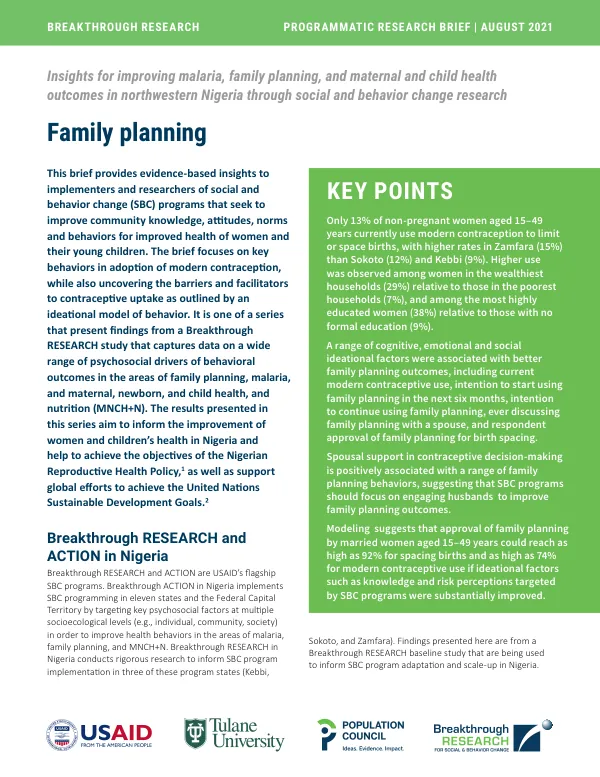
Health and Ideations of Married Female Adolescents—Insights for Improving Malaria, Family Planning, and Maternal and Child Health Outcomes in Northwestern Nigeria through Social and Behavior Change Programming
Sign inBREAKTHROUGH ACTION
Health and Ideations of Married Female Adolescents—Insights for Improving Malaria, Family Planning, and Maternal and Child Health Outcomes in Northwestern Nigeria through Social and Behavior Change Programming
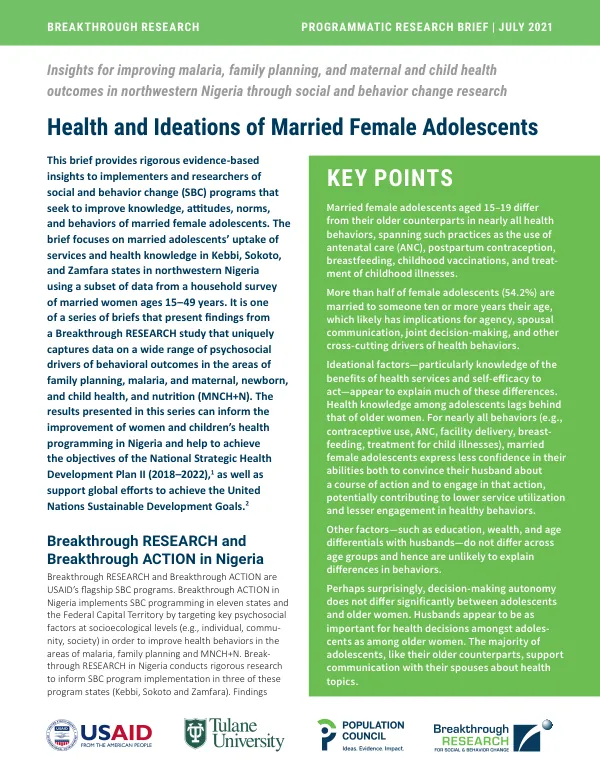
Married female adolescents aged 15-19 in northwestern Nigeria differ from their older counterparts in nearly all health behaviors, including the use of antenatal care, postpartum contraception, breastfeeding, childhood vaccinations, and treatment of childhood illnesses.
2021 · 8 pages
Sign in to readA free account is required to download.
Abstract
These differences are attributed to ideational factors, particularly knowledge of the benefits of health services and self-efficacy to act. More than half of female adolescents (54.2%) are married to someone ten or more years their age, which likely has implications for agency, spousal communication, joint decision-making, and other cross-cutting drivers of health behaviors. Health knowledge among adolescents lags behind that of older women, with nearly all behaviors (e.g., contraceptive use, ANC, facility delivery, breastfeeding, treatment for child illnesses) showing lower confidence in their abilities to convince their husband about a course of action and to engage in that action. The majority of adolescents, like their older counterparts, support communication with their spouses about health topics. However, decision-making autonomy does not differ significantly between adolescents and older women. Husbands appear to be as important for health decisions amongst adolescents as among older women. Adolescent girls in northern Nigeria typically face limited educational opportunities, and frequently experience early marriage and early childbirth, all of which are associated with greater health risks, including pregnancy complications that contribute to both neonatal and maternal morbidity and mortality. The median ages at first marriage (15.9 years) and first birth (18.1 years) are lower in the northwest than in any other region of Nigeria. The 2018 Nigeria Demographic Health Survey (NDHS) shows that nearly one-third (31.0%) of 15-year-old girls in the northwest are married, and, by the age of 18, almost one-third have a child. Women's empowerment and decision-making autonomy are lower in the northwest than in any other region. The majority of adolescent marriages are arranged by families, often against a girl's wishes and frequently with a considerably older man. Compounding these issues, many adolescent girls have limited knowledge of basic sexual and reproductive health, as well as limited awareness of key maternal and child health services. A 2015 study by the World Bank found that only 6.6% of 15- to 19-year-old Nigerian females were able to identify when a female is most likely to get pregnant during her ovulatory cycle. The 2018 NDHS indicated that more than four out of ten 15- to 19-year-olds in the northwest were unable to identify a single modern contraceptive method. The Breakthrough RESEARCH baseline study used a behavioral sentinel surveillance (BSS) baseline survey conducted between September and October 2019 in Breakthrough ACTION program areas in Kebbi, Sokoto, and Zamfara States of northwestern Nigeria. The survey included 3,000 married postpartum women aged 15-49 years, including 353 adolescents aged 15-19 years. The analysis presents weighted descriptive statistics for married female adolescents aged 15-19 years relative to married women aged 20-29 years and 30-49 years. The results show that female adolescents are less likely to engage in nearly all positive MNCH+N behaviors explored. Adolescents are less likely to make at least four ANC visits, receive intermittent preventive treatment during pregnancy (IPTp), and discuss with health providers key topics such as vaginal bleeding, baby's movements, due dates, danger signs during pregnancy, delivery plans, the presence of family members during delivery, transport, funds for delivery, and finding a skilled birth attendant. In the postnatal period, adolescents are much less likely to begin breastfeeding within one hour of birth relative to mothers aged 20 to 29 years and mothers aged 30 to 49 years. Similarly, for common childhood illnesses, adolescents are less likely to provide oral rehydration salts (ORS) and zinc for children with diarrhea and less likely to seek formal medical care for children with symptoms of pneumonia. The study used mixed-effects logistic regression models to derive predicted probabilities of nutrition outcomes, controlling for behavioral and ideational outcomes and sociodemographic characteristics, including household wealth, education (woman and spouse), and employment (woman and spouse). The results highlight the need for targeted interventions to improve the health behaviors and knowledge of married female adolescents in northwestern Nigeria.
Related documents
Documents in this collection
 2021
2021USAID DEC
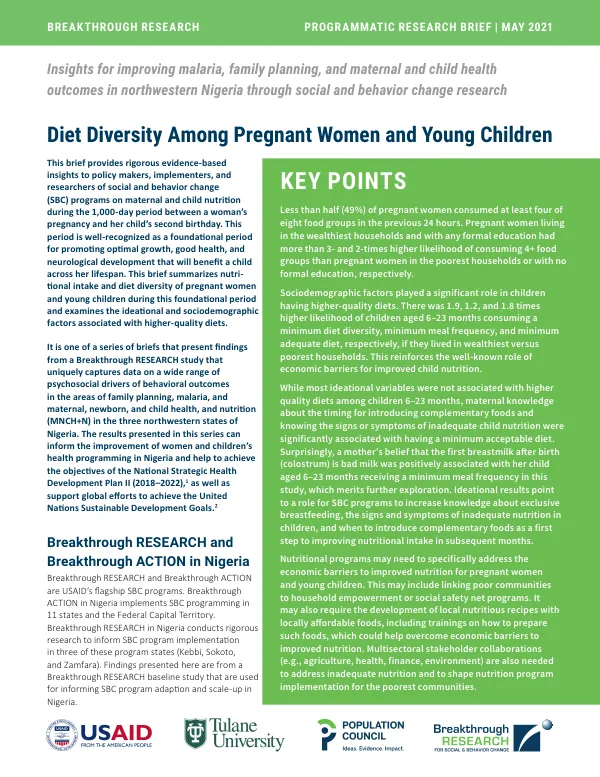
Diet diversity among pregnant women and young children—Insights for improving malaria, family planning, and maternal and child health outcomes in northwestern Nigeria through social and behavior change programming
Open record 2021
2021USAID DEC