USAID DEC
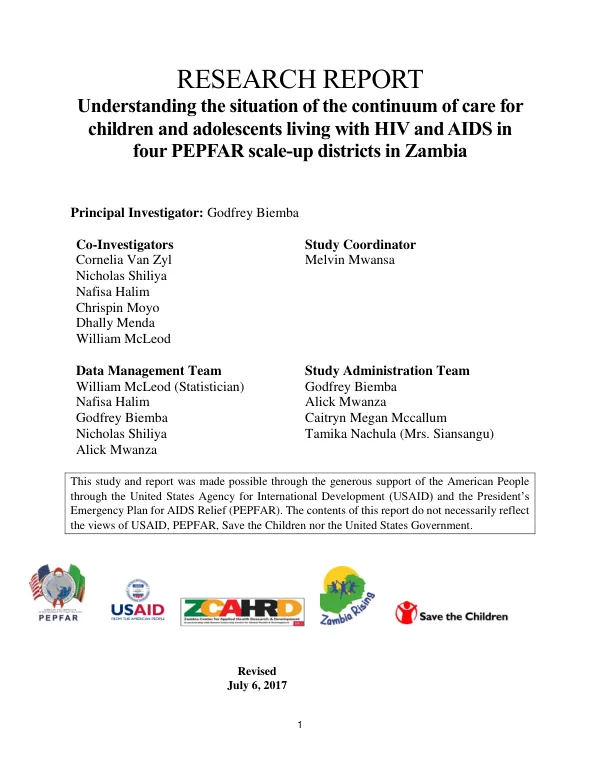
Research Report: Roll out of Caring for Children’s Healthy Growth and Development in Zambia: A Situational Analysis
Sign inELIZABETH GLASER PEDIATRIC AIDS FOUNDATION
Research Report: Roll out of Caring for Children’s Healthy Growth and Development in Zambia: A Situational Analysis
The Caring for Children's Healthy Growth and Development (CCHGD) training program in Zambia began in 2012 with the goal of promoting early childhood development (ECD) among children aged 0-8 years.
2017 · 31 pages
Sign in to readA free account is required to download.
Abstract
The program was initiated by the Government of the Republic of Zambia (GRZ) through the Ministries of General Education (MOGE), Health (MOH), and Community Development and Social Services (MCDSS). The training program aimed to equip service providers with the necessary skills to implement a holistic ECD program. The training program was initially funded by the United States Agency for International Development (USAID) and later by the Millennium Development Goals Acceleration Initiative (MDGi) and the Hilton Foundation. However, the program faced challenges due to inadequate funding, lack of policy direction, and a coordination mechanism. Despite these challenges, the training program has made progress, with 673 people trained in ECD throughout the country as of May 30, 2017. The situational analysis found that there are three ECD curricula available and currently being used in Zambia: Care for Child Development (CCD), Caring for Children's Healthy Growth and Development (CCHGD), and Zambia Adapted CCHGD. The training program has been rolled out in 20 districts out of 104, with the Copperbelt Province having the highest percentage of districts with ECD-trained personnel. The majority of the trainees were pre-school teachers and child care workers. The study also found that there is a lack of coordination among the three government ministries, with each ministry using a different training curriculum. The Tanzania training was specifically on CCD and was not used to adapt the Zambian CCHGD training program. The study recommends harmonizing the terminology and ECD training among the ministries to ensure consistency and effectiveness. The situational analysis also highlighted the need for a coordination mechanism to oversee the implementation of the ECD training program. The study suggests that a national coordination mechanism be established to oversee the implementation of the ECD training program and ensure that the training is rolled out consistently across the country. The study found that the training program has been successful in training a significant number of people in ECD, but more needs to be done to reach the target of 100% coverage. The study recommends that the training program be scaled up to reach more districts and provinces, and that a monitoring and evaluation system be put in place to track the progress of the training program. The study also highlights the need for quality assurance and quality control measures to be put in place to ensure that the training program is effective and of high quality. The study recommends that a quality assurance and quality control system be established to monitor the quality of the training program and ensure that it meets the required standards. Overall, the situational analysis provides a comprehensive overview of the CCHGD training program in Zambia and highlights the challenges and successes of the program. The study provides recommendations for improving the program and ensuring that it is effective in promoting ECD among children in Zambia.
Related documents