USAID DEC
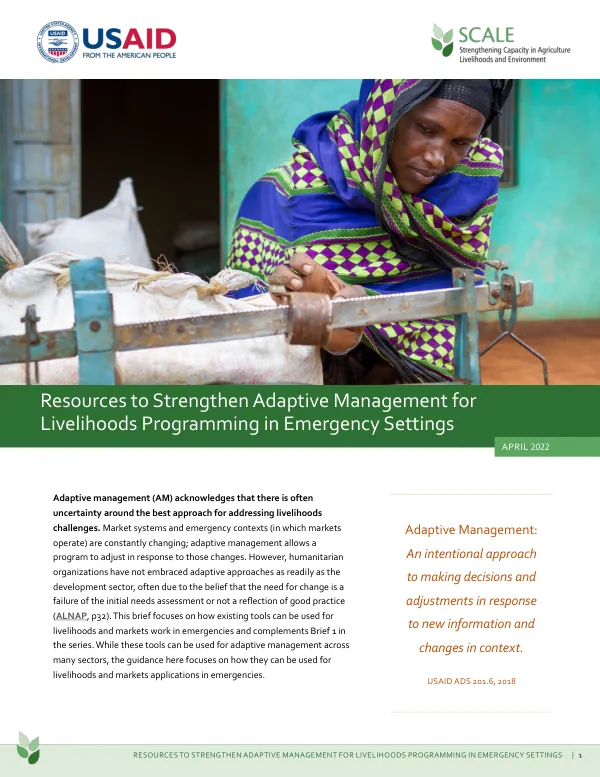
Resources to Strengthen Adaptive Management for Livelihoods Programming in Emergency Settings
Sign inUSAID
Resources to Strengthen Adaptive Management for Livelihoods Programming in Emergency Settings
Adaptive management acknowledges the uncertainty surrounding the best approach for addressing livelihoods challenges in emergency settings.
2022 · 6 pages
Sign in to readA free account is required to download.
Abstract
Market systems and emergency contexts are constantly changing, and adaptive management allows a program to adjust in response to those changes. Humanitarian organizations have not readily adopted adaptive approaches, often due to the belief that the need for change is a failure of the initial needs assessment or not a reflection of good practice. Adaptive management is characterized by building in opportunities for structured and collective reflection, ongoing and real-time learning, course correction, and decision-making designed to improve effectiveness. While desired outcomes may be fixed, the pathway to reaching those livelihoods outcomes is not, even when using "tried and tested" approaches. For example, to improve food security, many agencies provide seeds and tools after a crisis, but if a team found that appropriate seeds were available in the market, they may pivot towards seed fairs or vouchers, which have been shown to be equally, if not more, effective. A literature review revealed three specific challenges to adaptive management in a humanitarian context: the need for more decentralized decision-making, the need for data to support adaptation, and a lack of flexible funding. To address these challenges, a variety of resources are provided, focusing on increasing team capacity, building strategies that adapt, addressing operational challenges, supporting monitoring, evaluation, and learning, and improving partnerships. One resource, AdaptScan, provides tools, templates, and facilitation notes for workshops where an ongoing market or livelihoods project can incorporate adaptive management. Another resource, the ADAPT Self-Assessment Tool, provides a process and tool for self-assessment on adaptive management using a guided questionnaire. The Five Traits of Highly Adaptive Leadership Teams defines team and leadership practices for making teams more adaptive, while the Six Simple Rules for Managing Complexity without Getting Complicated provides leadership guidance on how to manage complex team dynamics created in teams during adaptive processes. In building strategies that adapt, the Knowing When to Adapt: Decision Tree guides users through the decision-making process on how and when to make adaptations and program changes. The Market Systems Development in Fragile and Conflict-affected Situations: Lessons for Donors and Implementers provides recommendations for MSD programming in fragile contexts and explains the difference between humanitarian approaches and MSD. The USAID Discussion Note: Adaptive Management explores AM as one of the four core principles of the Program Cycle and includes promising practices and practical approaches on how to operationalize adaptive management at each phase of the Program Cycle. In addressing operational challenges, the Incorporating CLA in the Procurement Process provides resources and advice on using adaptive management to design a procurement process. The Fit for Business: Modifying Internal Procurement Process to Suit Adaptive MSD Programs identifies key principles for modifying internal procurement processes to allow for adaptation in markets programming. The Using Contracts for Adaptive Programming provides useful principles for contracting in ways that support adaptive programming. Overall, adaptive management is a critical approach for addressing livelihoods challenges in emergency settings, and these resources provide a range of tools and guidance for implementing adaptive management in practice.