USAID DEC
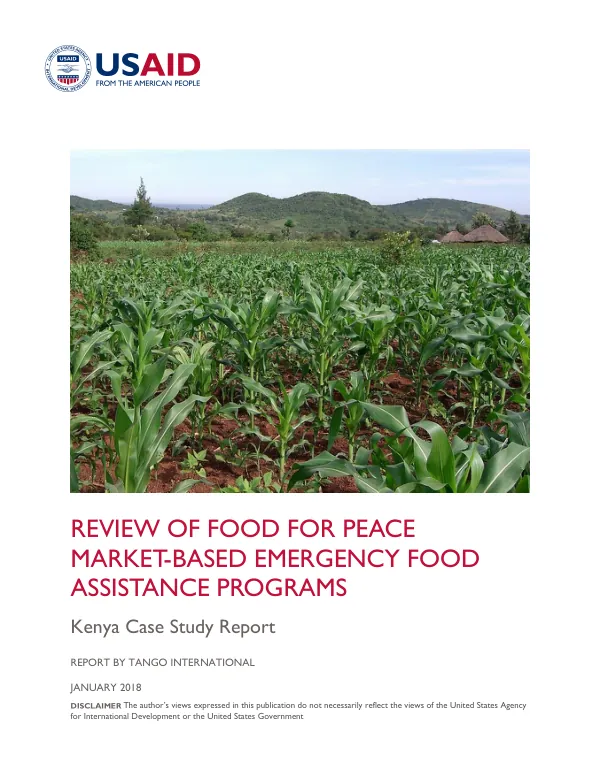
Review of Food for Peace Market-Based Emergency Food Assistance Programs: Kenya Case Study Report
Sign inTANGO, INTERNATIONAL INC.
Review of Food for Peace Market-Based Emergency Food Assistance Programs: Kenya Case Study Report
Kenya represents a country focused on building resilience through greater partnerships between USAID-Food for Peace (FFP) programs, other USAID-funded programs, and local and national government.
2018 · 33 pages
Sign in to readA free account is required to download.
Abstract
FFP MBEP in Kenya is a good example of connecting emergency and development programming and of government participation at national and county levels. It shows adaptations to varied conditions and the use of a range of modalities in response to recurrent drought and the influx of refugees due to regional conflict and drought. FFP implementing partners (IPs) are successfully reaching vulnerable Kenyan communities through a productive safety net and resilience-building asset creation program that use multiple modalities to respond to the specific and dynamic local contexts within Kenya. Use of food and cash assistance for assets activities are a critical base for larger resilience building partnerships between USAID programs and the government of Kenya. Within refugee camps, FFP in-kind food assistance is complemented by cash provided by other donors. Market-based modalities are better supported along Kenya's main transportation corridors, where infrastructure and markets are more stable. Increased investment in banking infrastructure and mobile networks has resulted in a cash delivery mechanism through mobile money that can reach more remote areas of Kenya. Targeted emergency food distribution and Food for Assets activities (FFA) have been considered more appropriate in the more remote arid regions in Northern Kenya, though some northern counties are shifting to cash assistance. A community-based targeting system coupled with a nationwide single registry system of beneficiaries allows FFP-supported programs to reach the most vulnerable households. Within refugee camps, FFP provides U.S.-sourced Title II in-kind food assistance. The UN World Food Programme (WFP) is FFP's main implementing partner in Kenya. The asset creation aspect of the project, along with the earned income, is credited by beneficiaries with improving food security and enabling them to use the cash in ways that would best support their livelihood, which in turn helps to improve food security. Most focus group participants expressed a preference for cash over food, stating that CFA helps to reduce food insecurity. Beneficiaries raised issues about rapidity of payments and timeliness of drought responses, a result of WFP's funding fluidity for cash transfer programs in Kenya. Drought has also limited asset creation benefits and increased food insecurity in intervention areas. FFP is instrumental to long-term development goals in Kenya and is the largest donor towards resilience building programs that aim to gradually shift from short-term humanitarian aid to long-term livelihood resilience. Financial inclusion and greater female empowerment are some of the development impacts at the household level. FGDs with female beneficiaries of CFA activities reported that they have seen greater decision-making power over the income that they bring into the household. This includes being able to save, invest in business opportunities, and freedom at the market. Over 23 million Kenyans now have some form of banking services and financial inclusion has been a core objective of WFP, including the expansion of banking infrastructure to more remote regions of Kenya. WFP's continual evaluation and modification of cash delivery mechanism and the increasing spread of mobile coverage throughout Kenya has resulted in greater use of mobile money. The use of mobile money has enabled FFP to reach more remote areas and has increased the efficiency of cash transfers. This has also enabled FFP to respond more quickly to emergencies and has improved the overall effectiveness of the program. The partnership between FFP and WFP has been instrumental in achieving these results. WFP's expertise in food assistance and FFP's funding have enabled the program to reach a large number of beneficiaries and to provide them with the support they need to improve their food security and livelihoods. The program has also been able to adapt to changing circumstances and to respond to emerging needs, which has enabled it to achieve its goals and to make a positive impact on the lives of the people it serves. FFP's investment in capacity building has also been critical to the success of the program. The program has provided training and technical assistance to local partners and has helped them to build their capacity to implement the program. This has enabled the program to be more effective and to reach a larger number of beneficiaries. Overall, the FFP MBEP in Kenya has been a successful program that has made a positive impact on the lives of the people it serves. The program has demonstrated the effectiveness of market-based emergency food assistance and has shown that it is possible to achieve long-term development goals through short-term humanitarian aid. The program has also highlighted the importance of partnerships and the need for coordination and collaboration between different stakeholders to achieve common goals.