USAID
Revisions to Program Cycle Policy
The Program Cycle is USAID's operational model for development programming to achieve more effective and sustainable results.
2016 · 2 pages
Sign in to readA free account is required to download.
Abstract
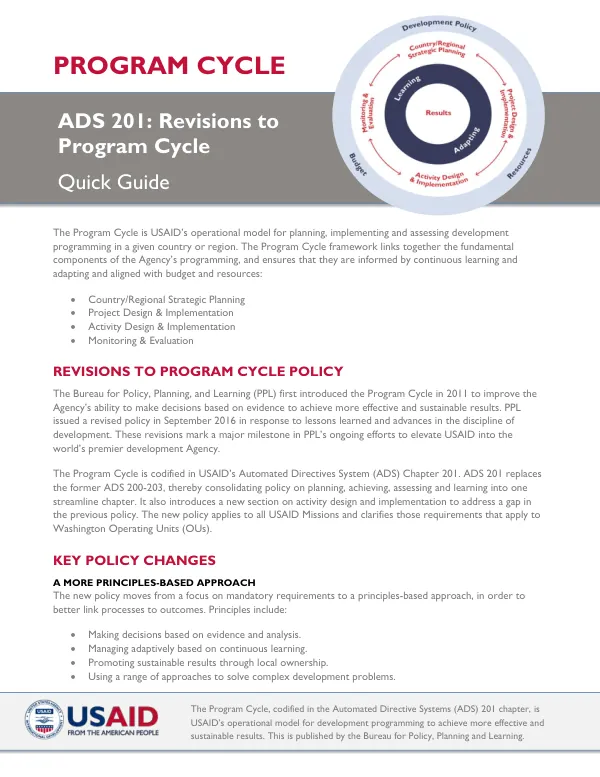
This model is codified in the Automated Directive Systems (ADS) 201 chapter, published by the Bureau for Policy, Planning and Learning. The Program Cycle framework links together the fundamental components of the Agency's programming, ensuring they are informed by continuous learning and adapting, and aligned with budget and resources. The framework consists of four key components: Country/Regional Strategic Planning, Project Design & Implementation, Activity Design & Implementation, and Monitoring & Evaluation. These components are designed to work together to achieve more effective and sustainable results. The Program Cycle was first introduced in 2011 by the Bureau for Policy, Planning, and Learning to improve the Agency's ability to make decisions based on evidence. In 2016, the Bureau for Policy, Planning, and Learning issued a revised policy in response to lessons learned and advances in the discipline of development. The revised policy, codified in ADS 201, replaces the former ADS 200-203 and consolidates policy on planning, achieving, assessing, and learning into one streamlined chapter. The new policy introduces a new section on activity design and implementation to address a gap in the previous policy. The revised policy adopts a more principles-based approach, focusing on making decisions based on evidence and analysis, managing adaptively based on continuous learning, promoting sustainable results through local ownership, and using a range of approaches to solve complex development problems. This approach gives Missions more flexibility to adapt to realities in the field by streamlining key processes and clarifying which procedures are mandatory and which are good practice. The new policy allows Missions to tailor their Country Development Cooperation Strategy (CDCS) to meet their unique circumstances, including those of non-permissive environments. It also replaces the project Concept Paper with a less onerous design plan, reduces the length of the Project Appraisal Document (PAD), and streamlines triggers for PAD amendments. Additionally, the policy reduces the number of indicators required for CDCSs and projects, shifts accountability to Intermediate Results, and enables a more targeted and iterative approach to analysis. The policy also enhances the use of knowledge from monitoring, evaluation, and learning (MEL) to inform future plans and adaptations to ongoing implementation. It simplifies the process for updating CDCSs and PADs to reflect changes in context and lessons learned, requires learning plans for strategies, projects, and activities, and facilitates monitoring for learning and performance improvement as much as for accountability and reporting. The revised policy also integrates related Agency priorities and facilitates more effective collaboration between Washington and the field. It creates a structured and time-bound process for the development and approval of the CDCS, requires Washington OUs and Regional Missions to obtain Mission concurrence before implementing activities in the field, and incorporates Agency priorities into the Program Cycle. The ADS is supplemented by capacity building resources, including training, technical assistance, tools, examples, and other materials. These resources are available on the USAID website and through ProgramNet.