USAID DEC
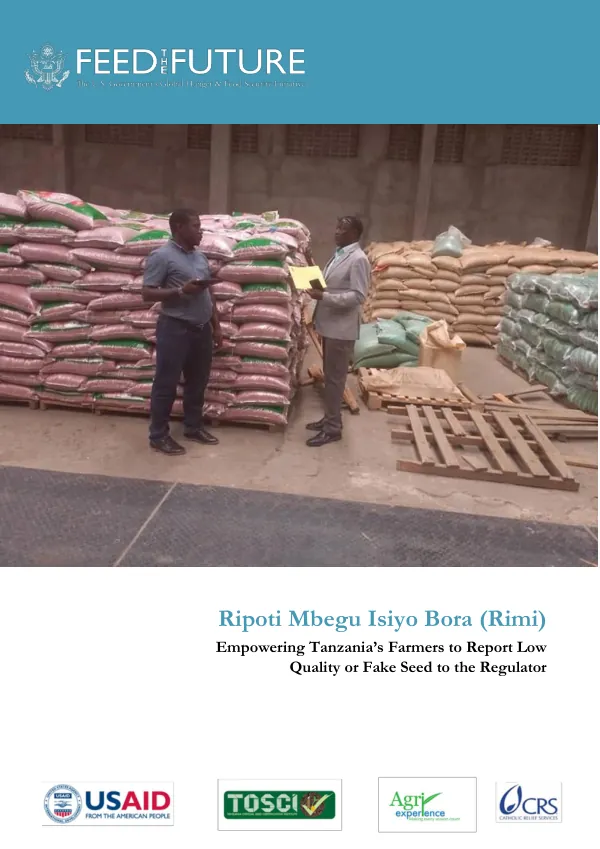
Ripoti Mbegu Isiyo Bora (Rimi): Empowering Tanzania’s Farmers to Report Low Quality or Fake Seed to the Regulator
Sign inCATHOLIC RELIEF SERVICES ORGANIZATION
Ripoti Mbegu Isiyo Bora (Rimi): Empowering Tanzania’s Farmers to Report Low Quality or Fake Seed to the Regulator
Tanzania is an agricultural country that relies heavily on the success of its agricultural sector for economic growth and food security.
2023 · 13 pages
Sign in to readA free account is required to download.
Abstract
It is estimated that agriculture employs around 66% of the population and accounts for about 30% of Tanzania's GDP. The right to food is recognized and protected in the Constitution of Tanzania, specifically Article 14, which guarantees the right to food as part of the broader right to life. Tanzania has made progress toward achieving food sufficiency, but challenges persist. The country has vast agricultural potential, with fertile land, diverse agro-climatic zones, and a wide range of crops and livestock. However, several factors affect Tanzania's food sufficiency, including rapid population growth, climate change, limited access to inputs and resources, post-harvest losses, and market inefficiencies. Achieving food sufficiency in Tanzania can be greatly facilitated by using high-quality, assured seed. High-quality, assured seed plays a crucial role in increasing agricultural productivity, crop yields, and overall food production. Tanzanian farmers depend on seed certified by the Tanzania Official Seed Certification Institute (TOSCI), a governmental institution within the Ministry of Agriculture established under the Seeds Act No. 18 of 2003. TOSCI is responsible for certification and control of quality agricultural seeds produced or imported into the country for sale. However, despite stringent certification protocols, Tanzanian farmers still risk purchasing low-quality or counterfeit seed. To address these challenges, TOSCI proposes to increase post-harvest seed inspection at the time of planting and also increase inspection visits to seed dealers. These steps will be of particular importance as the government plans to implement a seed subsidy in the upcoming planting season, as subsidies sometimes attract rogue traders. The use of high-quality, assured seed can lead to improved crop yields, better disease tolerance, higher market value, and enhanced profitability. A farmer empowerment tool named Ripoti Mbegu Isiyo Bora (RIMI - Swahili for “Stop Bad Seed”) was piloted in 2023 during the long rainy season in four regions of Tanzania: Ruvuma, Manyara, Songwe, and Mbeya. RIMI allows Tanzanian farmers to register complaints about fake and poor-quality seed with the country's regulatory body, TOSCI. Two approaches were taken to address the aforementioned challenges, including creating farmer awareness on the importance of using high-quality assured seed and implementing the RIMI farmer empowerment tool. Creating farmer awareness on the use of quality certified seed was done through interviews on two national television stations (AZAM TV and TBC TV) and three regional radio stations (KEY FM, FM Manyara, and Bomba FM). TOSCI officials discussed the concept of certified seed, its benefits, quality assurance, and common misconceptions. They also highlighted the availability of support services, such as those by agricultural extension officers, who can provide guidance on selecting the right certified seed varieties, proper agronomic practices, and management techniques to maximize the benefits of using certified seed. The RIMI system uses a shortcode “15009” for farmers to communicate their associated seed issues with TOSCI. The shortcode is mapped to Airtel, Tigo, and Vodacom and connected to a data management system managed by Echo Mobile. The system uses a survey-based methodology to collect information from farmers on their experience with low-quality seed. The RIMI system utilizes the following steps to gather, analyze, and respond to data: farmers send the keyword “TOSCI” to 15009 to activate the system, a series of questions are then sent back to the farmer to answer, and the system uses the collected data to identify trends and patterns in seed quality issues. The RIMI system has the potential to empower Tanzanian farmers by providing them with a platform to report seed quality issues and receive feedback on the actions taken by TOSCI. This can lead to improved seed quality, increased crop yields, and enhanced food security in Tanzania.
Related documents