CATHOLIC RELIEF SERVICES ORGANIZATION
Final Report: FY2014 - FY2018
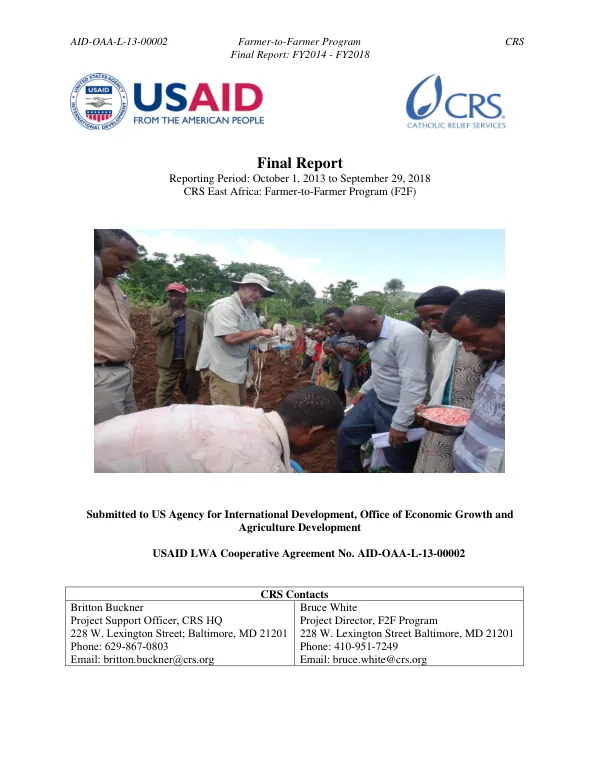
The Farmer-to-Farmer Program, implemented by Catholic Relief Services (CRS) in East Africa, aimed to improve agricultural productivity and food security in the region.
2018 · 243 pages
Sign in to readA free account is required to download.
Abstract
The program, which spanned from FY2014 to FY2018, focused on four core countries: Ethiopia, Kenya, Uganda, and Tanzania. CRS worked closely with USAID Missions in each country to align the program's goals and priorities with the Feed-the-Future (FtF) initiative. A value chain approach was adopted for each Country F2F Project, with a focus on grains, horticulture, livestock, dairy, and oilseeds. The program's objectives were to improve agricultural productivity, increase income for smallholder farmers, and enhance food security. To achieve these objectives, CRS implemented a range of activities, including farmer training, infrastructure development, and market linkage facilitation. One of the key features of the program was its emphasis on volunteer assignments. CRS recruited and managed a pool of volunteers, who were deployed to the core countries to provide technical assistance to smallholder farmers. The program's volunteer pool grew significantly over the course of the project, with a focus on recruiting women, new volunteers, and individuals from diverse backgrounds. The program's impact was significant, with CRS completing 500 assignments in the core countries. The assignments focused on a range of activities, including farmer training, irrigation system development, and market linkage facilitation. The program's results showed a significant increase in agricultural productivity, with farmers reporting improved yields and increased income. In addition to its core activities, the program also fostered collaboration and innovation within CRS. The program's team worked closely with other CRS program areas, including Impact Investment and Ethical Trade, to leverage resources and expertise. The program also integrated with CRS' microfinance work in the core countries, providing smallholder farmers with access to financial services and markets. The program's geographic focus was on the four core countries, with a focus on improving agricultural productivity and food security in the region. The program's timeframes were from FY2014 to FY2018, with a focus on achieving the program's objectives within this timeframe. The program's recommendations for future implementation included continuing to build on the program's successes, expanding the program's reach to new countries and communities, and leveraging the program's expertise and resources to support other CRS program areas. The program's methodology focused on a value chain approach, with a focus on improving agricultural productivity and increasing income for smallholder farmers. The program's key interventions included farmer training, infrastructure development, and market linkage facilitation. The program's results showed a significant increase in agricultural productivity, with farmers reporting improved yields and increased income. The program's implementation details included the recruitment and management of volunteers, who were deployed to the core countries to provide technical assistance to smallholder farmers. The program's volunteer pool grew significantly over the course of the project, with a focus on recruiting women, new volunteers, and individuals from diverse backgrounds. The program's results showed a significant increase in agricultural productivity, with farmers reporting improved yields and increased income.
Related documents