MERCY CORPS INTERNATIONAL
Risk and Resilience Assessment Case Study Series: Northeast Nigeria
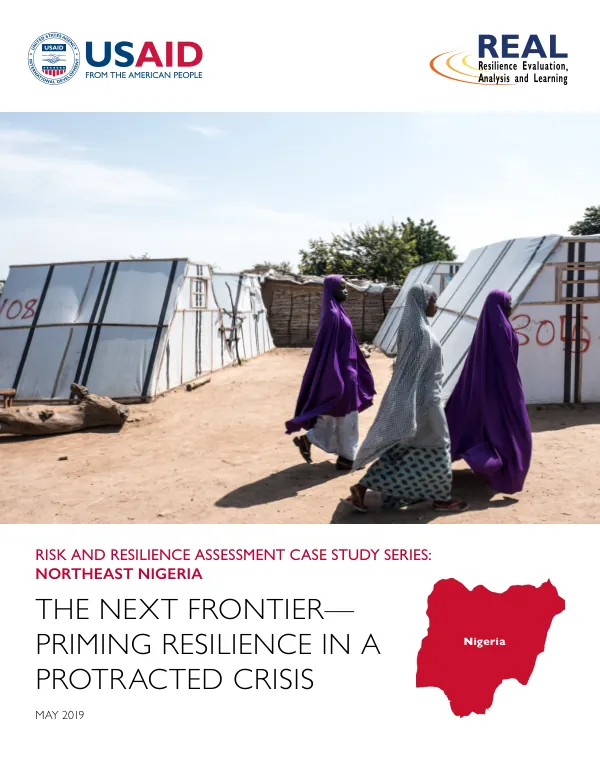
Northeast Nigeria is characterized by a protracted crisis that has left long-lasting impacts on human health and well-being, infrastructural destruction, environmental degradation, economic disruption, and governance challenges.
2019 · 20 pages
Sign in to readA free account is required to download.
Abstract
The conflict broke out in 2011, and despite recent improvements in humanitarian access, the scale of the crisis is overwhelming, with more than half the population needing humanitarian assistance, nearly a quarter being food insecure, and tens of thousands having been killed over the past ten years. The Borno state is characterized by significant inequality and marginalization, including high recruitment rates of boys who are vulnerable to enlistment into the Almajiri system. The return of those displaced, roughly two million people, and the reintegration of ex-combatants remain unresolved questions. Factors predate and exacerbate this conflict, making it crucial to invest in programming that reduces risks and strengthens the resilience capacities that can successfully manage adversity in northeast Nigeria. Mercy Corps conducted a Strategic Resilience Assessment (STRESS) in Borno State, Northeast Nigeria from May 2017–July 2018. The STRESS is a risk and resilience assessment methodology and participatory learning process that aims to understand the system dynamics, vulnerable groups, shocks and stresses, and key resilience capacities within a particular place. This assessment then guides the operational vision for strengthening resilience through programming, partnerships, and policies. The STRESS team encountered a wide-ranging set of challenges when implementing the STRESS process in a conflict-driven protracted crisis for the first time. These challenges included organizational dynamics, such as pitching the utility of resilience in the midst of a humanitarian crisis, addressing capacity-building challenges from turnover and operational constraints, and translating resilience terminology to make sense in a protracted crisis. The team also faced challenges navigating the operational environment, including centralized systems that could not keep pace with a fast-moving environment, access to field sites, and data quality. To meet these challenges, the STRESS team came up with a range of creative and adaptive solutions. They sought consistent messaging from senior leadership while also building buy-in at the working level on the value of a resilience approach. The team adopted a flexible staff engagement model grounded in informal learning and sharing opportunities to address capacity-building challenges. They kept an open mind and gained new insights from participatory approaches to translate resilience terminology for a protracted crisis. The team relied on their social capital and adaptive management skills to navigate rigid and centralized organizational systems. They hired diverse facilitators, sought diverse key informants, and practiced conflict sensitivity to compensate for their restricted site access. To manage weak data quality, the STRESS team pursued a range of innovative ideas, including identifying and collaborating with new stakeholders that had access to important data, holding roundtables to generate and validate data, and triangulating their findings across many sources. The team found that better coordination as well as empowerment through participatory approaches can strive to mitigate the realities of survey fatigue and participants' short-term priorities, as well as the potential for unmet expectations and reduced impact amidst complex and fast-changing dynamics. The STRESS process in Borno State, Northeast Nigeria, provided valuable lessons for practitioners who are considering conducting a similar assessment in a protracted crisis.