CHEMONICS
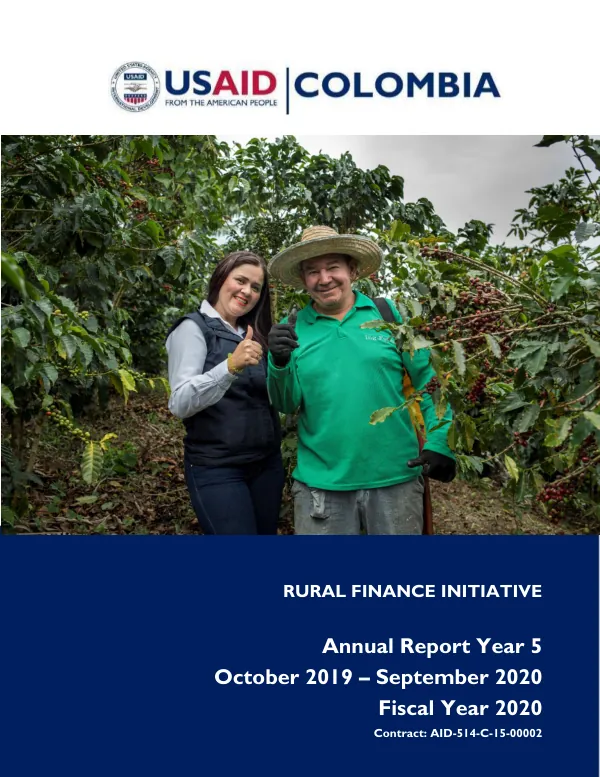
Rural Finance Initiative Annual Report Year 5
Colombia's sophisticated financial sector largely fails to reach rural producers.
2020 · 55 pages
Sign in to readA free account is required to download.
Abstract
The Rural Finance Initiative (RFI) is committed to reducing barriers of risk, cost, and information to help producers access financial services, ultimately boosting economic growth and working to break mutually reinforcing cycles of inequality and conflict. Through Year 5, RFI linked more than 855,000 rural clients, half of them women, with more than $1.1 billion in financial services. This exceeded life-of-project targets of 200,000 clients and $500 million in services. RFI achieved these results by forging alliances with 15 financial intermediaries (FIs), including commercial banks, cooperatives, and microfinance NGOs. RFI provided technical assistance and incentives for financial intermediaries to adjust their business model to serve rural clients by tailoring products, expanding channels, reducing transaction cost and risk, leveraging value chain opportunities, and promoting digital financial services. This allowed RFI to fine-tune a market-driven services model and learn lessons to further expand inclusion. Since the RFI contract was originally slated to conclude in July 2020, RFI spent Quarters 1, 2, and 3 consolidating successes and disseminating lessons, while preparing for close-out. Once USAID awarded the 18-month extension period at the end of April 2020, RFI pivoted to re-engage existing and new partners to design and launch activities. Sustainability of financial services was achieved through market expansion, with FIs investing more of their own funds in profitable operations. By the end of Year 5, RFI had leveraged a total of $29.9 million from partner FIs. Continued market expansion was achieved through incentive grants for market expansion, which helped partner FIs open 93 banking correspondents (BC) and six branches in target municipalities despite the pandemic. This included branch offices from Interactuar, Utrahuilca, and Contactar. RFI exceeded the 1:3 leverage requirement, with banks contributing more of their own resources for expansion, responding to the profitable rural business opportunities they saw. Value Chain Finance (VCF) was introduced to rural Colombia, developing a model that enables FIs to deliver financial services to multiple actors along agricultural value chains. This allows banks to reduce costs and risk by accessing small producers who might not otherwise qualify for loans, through an anchor organization, like a producer group. To date, the Initiative has helped FIs engage with 58 anchor organizations, resulting in 1,850 loans worth COP $23 billion (approximately $7.3 million). Improved digital enabling environment was achieved through laying the groundwork for digital financial services, with the potential to drive financial inclusion by reducing cash and in turn, transaction cost. For example, RFI helped ACH-Colombia develop and launch the country's first platform for small-value, real-time transactions, called Transfiya. In Year 5, RFI helped ACH engage additional financial institutions to participate in the platform. Transfiya had processed over 919,000 transactions worth over COP $130 billion (approximately $35.1 million) by September 2020. Gender and Vulnerable Populations (GVP) was addressed through interventions that benefit the whole rural population, but especially women and women-owned enterprise. During Year 5, RFI conducted a GVP assessment of activities to inform future programming and continued training FIs in customer service inclusive of women, ethnic groups, and other vulnerable populations. RFI also engaged Fundación Nuevo Renacer, a women-led organization located in Valencia (Córdoba), and trained them in the Local Savings and Credit Groups (GLAC) methodology. The foundation created 81 groups with 1,381 people and adapted the model to online sessions when COVID-19 restrictions were in place.
Related documents