MANAGEMENT SYSTEMS INTERNATIONAL
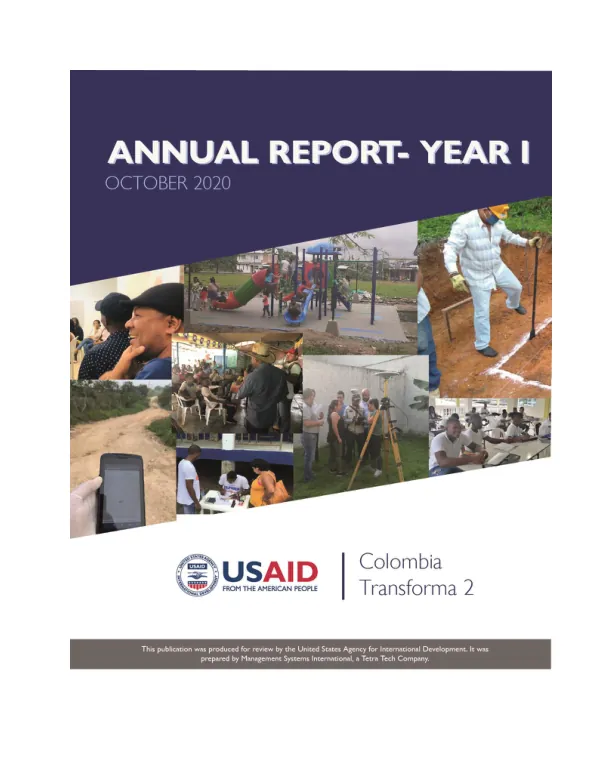
USAID/OTI Colombia Transforma 2 Annual Report – Year 1
Colombia Transforma 2 (T2) began implementation in July 2019 to contribute to the sustainability of the Peace Agreement signed in 2016 by the Government of Colombia and FARC guerrillas.
2020 · 26 pages
Sign in to readA free account is required to download.
Abstract
The project's primary objective was to promote the territorial legitimacy and implementation mechanisms of the Peace Agreement in Colombia's most challenging areas. T2 built on the knowledge acquired from four years of support to the Government of Colombia's political efforts (2015-2019) and shifted its work from Arauca and Putumayo to Bajo Cauca Antioqueño and Pacifico Nariñense, continuing its work in Norte de Santander. During its first year, T2 implemented more than 200 activities worth $7 million USD, targeting windows of opportunity such as local authorities' electoral transitions, renewed interest in the territorial development plans (PDETs), and the COVID-19 health emergency. These activities engaged 112 partners and benefited more than 1 million inhabitants of Colombia's most critical and vulnerable municipalities. The program's field-based orientations, conducted in October 2019 and June 2020, helped to define the program's clusters and prioritize critical geographies, actors, and types of activities. The December 2019 rolling assessment recognized the post-election turnover of municipal and departmental authorities as key entry points for promoting the Peace Agreement's territorial legitimacy and implementation mechanisms. This recognition resulted in the implementation of 11 activities centered on obtaining political buy-in and commitment to the PDETs from new municipal mayors and departmental governors. The efforts' success was evinced by the inclusion of 1,168 PDET initiatives in government plans in the next four years. Networking and collaborative relationships are critical components for peace accord implementation and the transformation of the central government's relationship with territories. T2 contributed to the piloting of the Agency for Territorial Renewal's (ART's) System of Networks Strategy in Catatumbo, supported the expansion of the university, state, and private sector committee in Bajo Cauca, and facilitated the creation of the PDET working groups in Pacifico Nariñense. These initiatives are becoming the primary spaces for dialogue and action for the rural integral reform laid out in the Agreement. The programmatic teams used the COVID-19 emergency as an opportunity to showcase advancements in the provision of educational, health, and justice services in rural areas affected by armed conflict. The pandemic context expanded the number and type of grantees to benefit from T2, including actors such as the Health Ministry, Proantioquia, and a teachers' network in Catatumbo. The pandemic also highlighted new avenues and limitations for achieving T2's goals virtually. The reporting period brought opportunities and challenges to T2, including the deterioration of security conditions, clashes among illegal armed groups, and tensions over forced coca crop eradication. T2 also faced the pandemic's ongoing impact on public sector finances and social capital, mounting polarization in anticipation of the 2022 presidential campaign, and local authorities' and communities' desire for concrete action on PDETs and the Peace Agreement. In its first phase of OTI programming (June 2015-September 2019), Colombia Transforma (TO 7200AA19F00010) executed 621 activities to support the political transition laid out in the Peace Agreement with the Revolutionary Armed Forces of Colombia (FARC) guerrilla group. Over four years in the departments of Arauca, Norte de Santander, and Putumayo, Transforma supported national and territorial rapid response initiatives related to the signing of the Peace Agreement and the 2016 referendum plebiscite. It assisted with the Agreement's initial implementation in collaboration with new institutions such as the Agency for Territorial Renewal (ART), the National Land Agency (ANT), and the Rural Development Agency (ADR) and generally aided the transition.