USAID
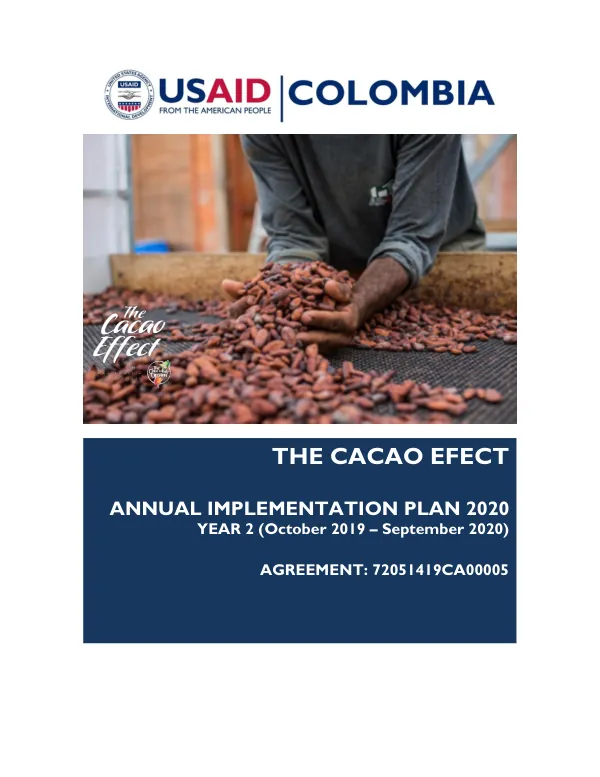
Annual Implementation Plan 2020: The Cacao Effect
The Cacao Effect is a Cooperation Agreement supported by the United States Agency for International Development (USAID) and an alliance between Luker Chocolate, Luker Foundation, Enel-Emgesa, Saldarriaga Concha Foundation (FSC), and EAFIT University.
2020 · 24 pages
Sign in to readA free account is required to download.
Abstract
The agreement aims to strengthen the cacao productive value chain, contributing to better living conditions of producers and their communities as a basis for the construction of a long-lasting peace. The total investment of the five-year agreement will be USD $35.103.407, including a USD $6.260.000 grant from USAID. The agreement initially included municipalities of three sub-regions: Urabá, Bajo Cauca, and Huila. However, at the end of the first year of implementation, all allies agreed to include the municipality of Tumaco. The Annual Implementation Plan covers the period from October 1st, 2019, to September 30th, 2020, and is the second year of implementation. The implementation of the activities has been achieved through the participation of institutions that have closely monitored the progress and activities through three established committees: Strategic, Communications, and Operational. All partner institutions participate in each committee. The Annual Implementation Plan was prepared using a participatory planning methodology during a 16-hour long workshop, where 32 people participated on behalf of all the partners of the Activity. The plan assumes that the goals of the first year were accomplished, except for two specific cases that will be explained in the next section. The specific activities of the FY 2020 Annual Implementation Plan focus on increasing cacao crop productivity, strengthening cacao producer associations, and improving competencies of the population surrounding the anchor crop in Necoclí. The plan includes three intermediate results: Increased productivity in cacao crops, Strengthened associations of cacao producers, and Improved competencies of the population surrounding the anchor crop in Necoclí. The plan also includes cross-cutting activities, such as an inclusion strategy, a communication strategy, and interinstitutional coordination. The budget for the agreement is USD $35.103.407, including a USD $6.260.000 grant from USAID. The work team includes partner institutions that participate in each of the three committees established to monitor the progress and activities. The plan includes a monitoring and evaluation system to track the progress and results of the activities. The plan also includes a section on challenges, which highlights the need to address specific cases that were not accomplished in the first year of implementation. The plan concludes with a section on annexes and tables, which provides additional information on the goals and objectives of the agreement. The Cacao Effect agreement aims to improve the quality of life of cacao-producing families through the strengthening of their skills and the increase of productivity. The agreement has a total investment of USD $35.103.407, including a USD $6.260.000 grant from USAID. The plan includes specific activities to increase cacao crop productivity, strengthen cacao producer associations, and improve competencies of the population surrounding the anchor crop in Necoclí. The plan assumes that the goals of the first year were accomplished, except for two specific cases that will be explained in the next section. The plan includes a monitoring and evaluation system to track the progress and results of the activities. The plan also includes a section on challenges, which highlights the need to address specific cases that were not accomplished in the first year of implementation. The agreement has a total investment of USD $35.103.407, including a USD $6.260.000 grant from USAID. The plan includes specific activities to increase cacao crop productivity, strengthen cacao producer associations, and improve competencies of the population surrounding the anchor crop in Necoclí. The plan assumes that the goals of the first year were accomplished, except for two specific cases that will be explained in the next section. The plan includes a section on cross-cutting activities, which highlights the importance of inclusion, communication, and interinstitutional coordination. The plan also includes a section on management and administration of the agreement, which highlights the need for a strong work team and a monitoring and evaluation system. The plan concludes with a section on annexes and tables, which provides additional information on the goals and objectives of the agreement.
Related documents