USAID. MISSION TO GUATEMALA
Rural potable water and sanitation
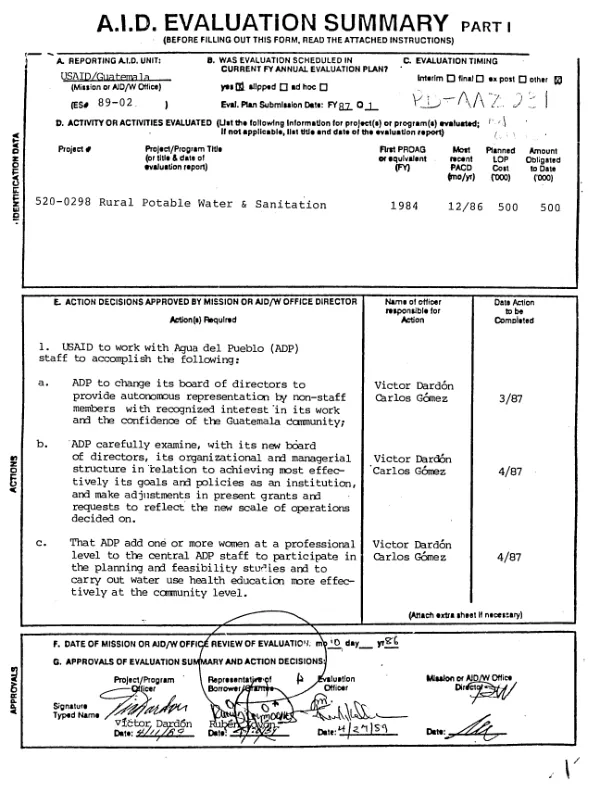
Summarizes a mid-term external evaluation (1/84-6/86) of a project implemented by Agua del Pueblo, a Guatemalan PVO, to improve potable water and sanitation services in 62 rural communities.
1989
Sign in to readA free account is required to download.
Abstract
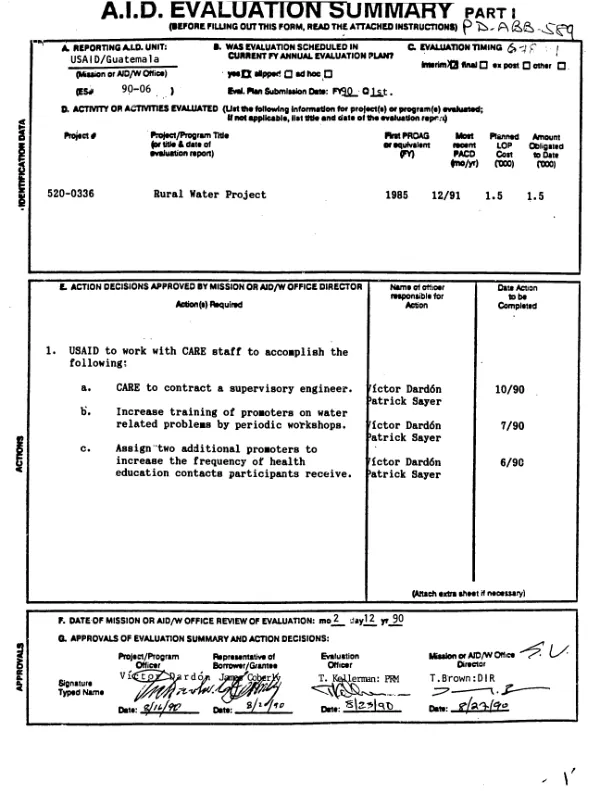
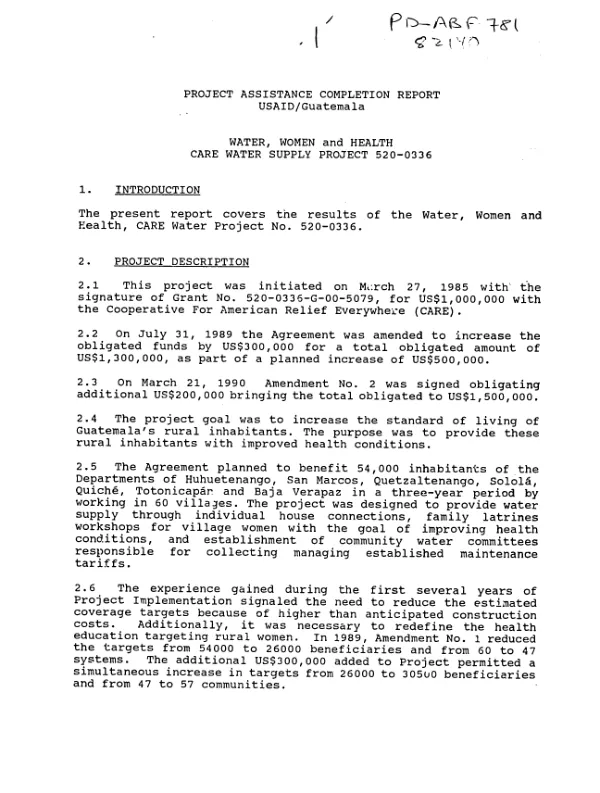
That evaluation (PD-AAZ-234) also covers a predecessor project implemented by Agua del Pueblo (5200298) and a related project implemented by CARE (5200336). The project has been delayed by Agua del Pueblo"s general managerial problems and by a devaluation of the Quetzal, which tripled the funds available for project 5200298 and forced Agua del Pueblo to throw its whole staff into implementing that project to assure disbursement of funds before the PACD. Nonetheless, most objectives of the present project should be attained by the 6/30/88 PACD. The installation of latrines is showing positive environmental benefits in the communities where the project has been carried out with the help of the Ministry of Public Health or a cooperating agency. Also, Agua del Pueblo has helped develop local water committees, which collect community contributions and disburse funds for construction costs, operation and maintenance, etc. Women, however, have not been been integrated into project implementation. Agua del Pueblo should consider establishing an advisory board representative of primary donors and of its own original founders to guide it through its reorganization process. The PVO should also consider selecting only small gravity-flow systems to serve areas with populations not exceeding 600 and where a rural aqueducts technician can be stationed to closely supervise a small number of projects simultaneously, provide better preliminary studies/approaches, and coordinate activities with other agencies. Several lessons were learned. (1) Providing beneficiaries with environmental sanitation education is very important to ensure that the water and latrines will actually benefit the users. (2) The design of large projects is beyond the technical capacity of rural aqueducts technicians. (3) Health education should commence simultaneously with construction. (4) Latrine construction should not be delayed until the construction of the water system is completed. (5) Perhaps most importantly, project objectives for Agua del Pueblo should be more flexible so that resources can be used to provide a greater number of beneficiaries a full range of services rather than to establish a specific number of systems. The effective and long-term viability of the water systems should be emphasized.
Related documents