 1986
1986USAID DEC
USAID. MISSION TO KENYA
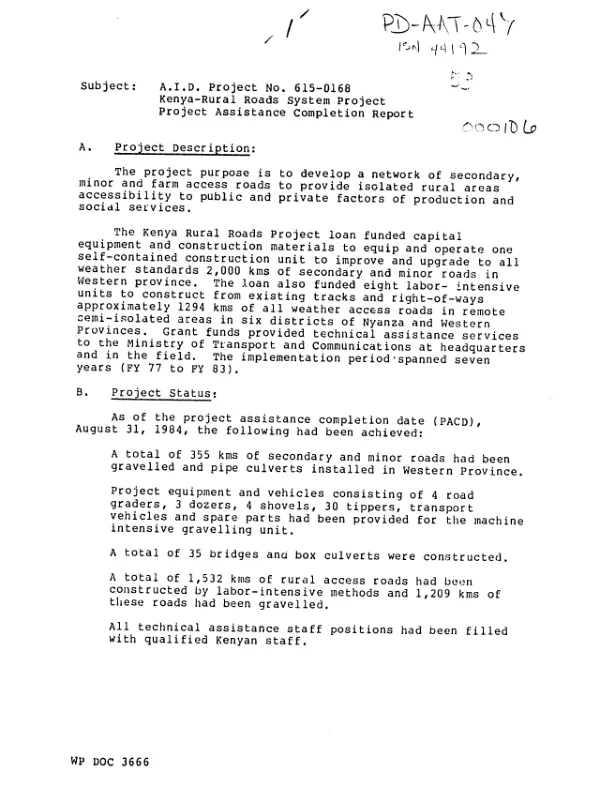
Evaluates two projects - Roads Gravelling and Rural Roads Systems - to improve rural roads in Kenya.
Shah, S. P.; Penndorf, C. · 1979
Abstract
PES covers the period 7/78-6/79 and is based on USAID/K Quarterly Reviews (the last of which is appended) and the Annual Joint Donors" Review (appended). Late arrival and unsatisfactory condition of equipment will delay initiation of work by the Gravelling, Bridging, and Culverting (GBC) construction units until 9/79, and only 34% of needed personnelhave been recruited. However, the first GBC unit is already sufficiently staffed, and the Ministry of Works (MOW) will recruit from the private sector so as not to further delay construction. Candidate roads and base camps have been selected and prospects for success in this activity are very good. It is noted that construction progress will depend on the relative proportion of road sections needing total reconstruction to sections needing spot improvements. As of 5/31/79, six construction units of the Rural Access Roads component (6150168) have completed 116.7 km of earthwork (60% of target), but only 7.4 km of these have been gravelled due to poor onsite planning, improper quarry selection, and poor use of equipment. On the basis of experience of road projects in Kenya, it is recommended that the average construction rate be revised downward to 36 km per unit-year; this will still allow the overall target of 942 km to be met by 1982. Decentralization of program management and training programs have largely corrected the trained personnel shortage, but officers-in-charge are still in short supply. The previous years" pilot road maintenance project failed due to lack of equipment, spare parts, and money, and also because selected roads were not up to maintainable standards. A funding commitment from the MOW, a cost accounting system, and a set of maintainable roads should ensure success of the present program. Other recommendations are to: reexamine the requirement to gravel all roads; revise road selection criteria; retain the stated fixed amount reimbursement (FAR); and disburse 40% of FAR upon satisfactory completion of earthwork.
Connected topics
Classification