USAID
Rural Women and Health in the Sudan
In rural areas of the Sudan, women play a crucial role in sustaining the life of the community.
2009 · 16 pages
Sign in to readA free account is required to download.
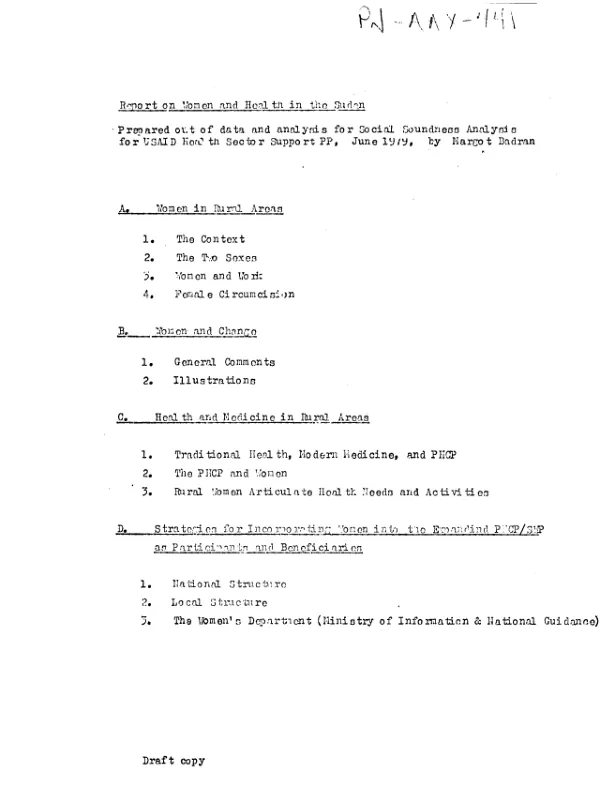
Abstract
The traditional rural community has a mixed economy, with both nomadic and settled populations. The entire population, including adults, children, and men, is involved in sustaining the community, with a simple system of division of labor articulated in complementary rules and functions. Traditions and customs are respected and preserved by the community, with a considerable blurring between the moral/religious order and the practical order. In the traditional rural community, there is a mixed degree of socioeconomic interaction between the sexes, true both in the Islamic North and the Christian South. Private or domestic space is predominantly the domain of women, with all members of the family having access to this space, except men. This has crucial implications for various development programs, such as when children's health improvement, women's and men's participation, and domestic context as well as public or social context are considered. With the move away from a subsistence economy to a cash economy, the traditional complementary and cooperative socioeconomic interaction of the sexes is disrupted. With the introduction of modern salaried cadres, women are often left behind. A case in point is the new CMIT (community health officer) introduced in the Sudan, with only 5 out of 394 being women, earning a salary of £24 as opposed to £10 per month for another frontline health worker, the midwife. Women in rural areas of the Sudan have a hard and long life of production and reproduction. Unlike men, women are involved in both the domestic sphere and the public or social sphere. The domestic sphere is characterized by early marriage for women and multiple childbearing, often with no more than half the children surviving infancy. Women are responsible for nurturing men and children, involving them in tasks of processing, apportioning, storing, and sometimes producing food. They run and maintain the household, are responsible for domestic sanitation and family hygiene, fetch water for household use, nurse family members in illness, provide early instruction in life and certain habits, etc. Women are active in agriculture and pastoralism in tasks either the same or complementary to men's. There are considerable variations in economic participation in different parts of the Sudan, which developers should take account of. Women barter or sell foods and/or crafts they produce themselves. In the South, a common means of additional income for needy women is brewing and selling beer. Women gain a livelihood through traditional occupations such as shaiji, as 'curious' leaders of zar, corporations dealing with 'possessed' women, a kind of folk psychological treatment, midwives (who are being trained to enter the world of modern medicine and are key personnel in the PHC program), etc. Female circumcision is predominantly a phenomenon of the North. It is linked with ritual cleanliness and social respectability by the majority of women and men in both urban and rural areas. Modern medical and social research in the Sudan, as elsewhere, is demonstrating the ill effects - physical and psychological - to women, as well as the high reproductive morbidity and mortality of the practice. The PHC program is actively working to reduce and ultimately eliminate the practice of female circumcision. A recommended approach would be to interface with and support current Sudanese efforts to reduce, and ultimately eliminate, the practice of female circumcision. The Overseas Development Cooperation is currently funding a national epidemiological study of female circumcision which involves interviewing women and men in rural and urban areas. Change or modernization in rural areas has been a lowly and unevenly spread phenomenon. Good governance has been a significant determinant of the course of change. In average societies, change has brought more benefits than communities remote from the Nile, such as Jazira Province, which has been the target of large irrigation schemes since the 1960s, and is far more developed than, say, the western provinces. The sedentary population has experienced more change (most notably that nearer the Nile, provincial capitals, important markets, etc.) than nomads who, on the whole, remain at the periphery of development. The South is far less developed than the North, in part due to the devastating effects of the civil war. In both North and South, men and women have been differentially beneficiaries of change