GOVERNMENT OF SENEGAL
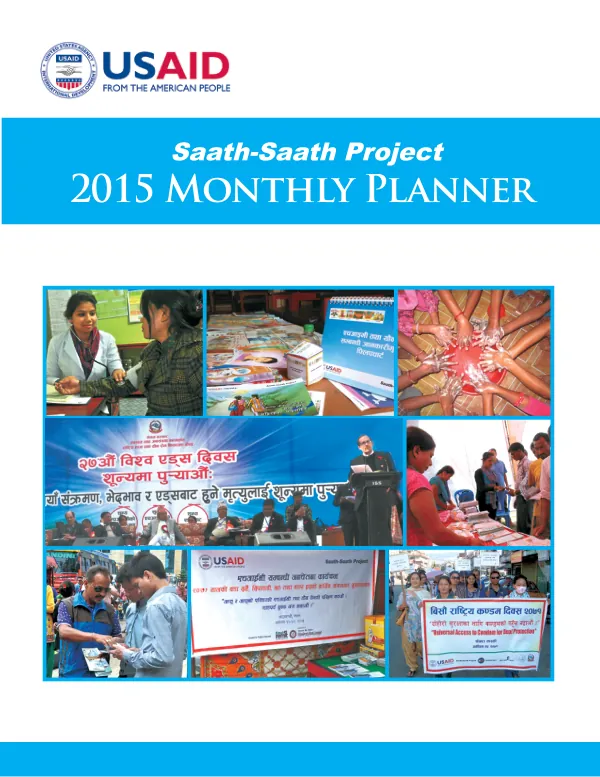
Saath-Saath Project Monthly Planner
The Saath-Saath Project is a collaborative initiative between the Government of Nepal and the United States Agency for International Development (USAID) to reduce the transmission and impact of HIV/AIDS and improve reproductive health among selected key affected populations (KAPs) in Nepal.
2015 · 32 pages
Sign in to readA free account is required to download.
Abstract
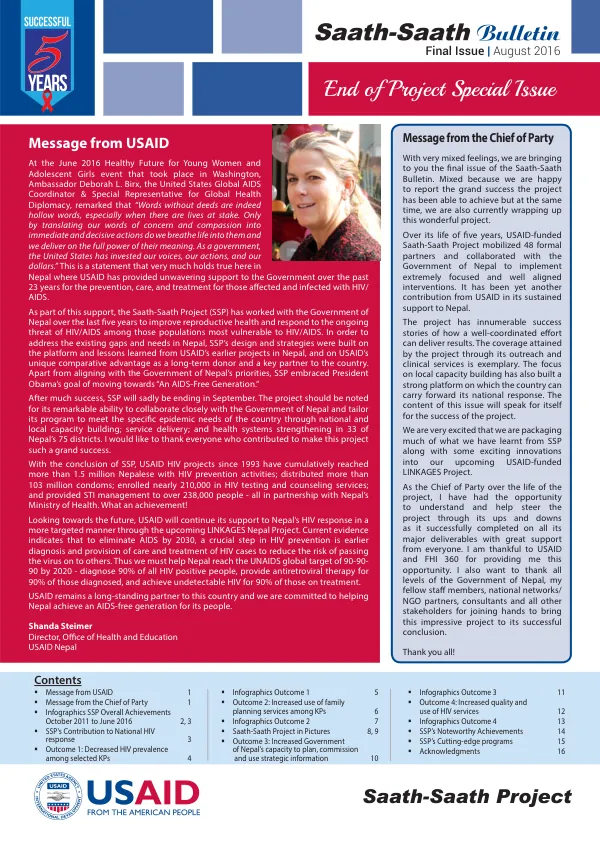
The project aims to strengthen country and local ownership, increase effectiveness, institutionalize coordination and collaboration, and build local capacity. The project works in 33 districts across Nepal, focusing on key affected populations such as female sex workers (FSWs), clients of FSWs, migrants, spouses of migrants, and people living with HIV (PLHIV). The project's goal is to reduce HIV prevalence among these populations, increase the use of family planning services, and improve the capacity of the Government of Nepal to plan, commission, and use strategic information. The project has achieved several key results, including reducing HIV prevalence among FSWs to 2%, increasing the Contraceptive Prevalence Rate (CPR) among migrant couples to 30% in four districts, and reaching 43,000 FSWs through targeted HIV prevention services. The project has also provided HIV care and support services to 10,000 PLHIV and reached 7,500 FSWs and transgender sex workers (TG SWs) with specific interventions addressing gender-based violence (GBV) and coercion related to HIV/AIDS. The project has also conducted various capacity-building activities, including training for 23,408 people, including FCHVs and health workers, in areas such as stigma and discrimination reduction, HIV prevention, and medical injection safety. The project has also established a network of service sites providing HIV prevention, care, and support services, as well as family planning counseling and services. The project's achievements are reflected in the data, which shows that 287,556 people were reached for HIV prevention through outreach and condom distribution among KAPs, and 4,721 PLHIV were treated for sexually transmitted infections (STIs). The project has also made significant progress in increasing the use of family planning services among KAPs, with a 49% increase in CPR among migrant couples. The project's geographic focus is on 33 districts across Nepal, with a particular emphasis on the Kathmandu Valley and other high-risk areas. The project's timeframes are from October 1, 2011, to September 30, 2016, with a goal of reducing HIV prevalence and improving reproductive health among KAPs. The project's implementation details include a range of activities, including outreach and condom distribution, HIV testing and counseling, and capacity-building training for health workers and FCHVs. The project also works closely with the Government of Nepal, the National Center for AIDS and STD Control (NCASC), and other stakeholders to ensure effective coordination and collaboration. The project's recommendations and future plans include continuing to strengthen country and local ownership, increasing effectiveness, and institutionalizing coordination and collaboration. The project also aims to build local capacity and improve the capacity of the Government of Nepal to plan, commission, and use strategic information. The project's monthly planner provides a detailed schedule of activities and events, including holidays and celebrations such as Saath-Saath Project Holidays, Martyrs' Day, and International Women's Day. The planner also includes space for personal details, professional details, and medical details, as well as a calendar of events and activities for the month.
![Changes in Service Availability, Readiness, Process of Care, and Client Satisfaction with Family Planning Services: A Comparison between the 2015 and 2021 Nepal Health Facility Surveys (FA147) - Analysis Brief [AB41]](https://covers.devme.ai/gen/138852.webp)