FHI 360
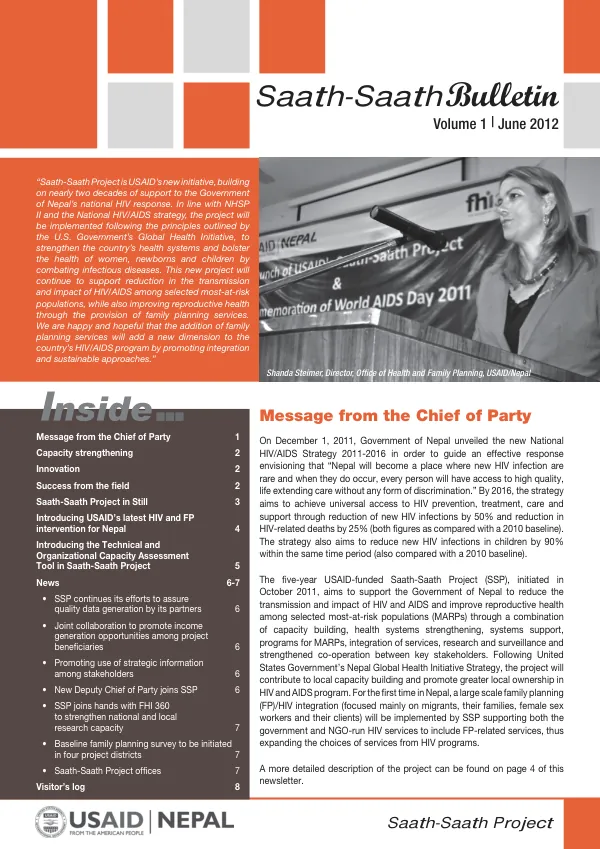
Final Issue: Saath-Saath Bulletin August 2016
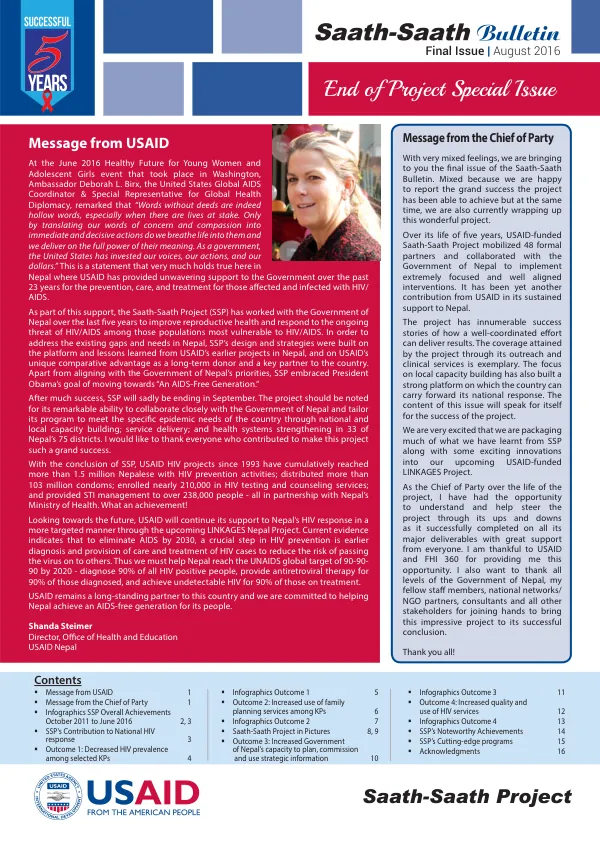
The Saath-Saath Project (SSP) was a five-year initiative funded by USAID that aimed to improve reproductive health and respond to the ongoing threat of HIV/AIDS among key populations in Nepal.
2016 · 16 pages
Sign in to readA free account is required to download.
Abstract
The project was designed to be aligned with the Government of Nepal's priorities and was implemented in close coordination with the government and other key stakeholders. The project targeted key populations, including female sex workers, their clients, migrants, and people living with HIV, through a range of interventions. These included HIV prevention, care, support, and treatment services, as well as gender-based violence prevention and mitigation services. The project also extended its support to systems strengthening, providing technical assistance to enhance the capacity of the government and local civil society. SSP was successful in completing all its capacity building initiatives and supported the strategic information system, generating, analyzing, and using valuable new pieces of information to inform decision-making. The project reached more than 500,000 people with its prevention outreach and Drop-in Center efforts, provided STI management and HIV testing services to nearly 110,000 individuals, and offered palliative services to close to 12,000 people living with HIV. The project's achievements were notable, with more than 30 million condoms distributed and almost 47,000 people receiving family planning counseling, of which nearly 3,600 adopted family planning methods. The project's success was also reflected in the increased use of family planning services among key populations, with a significant proportion of individuals adopting family planning methods. SSP's impact was further amplified by its collaboration with local NGOs and national networks, as well as its use of government health facilities in selected districts. The project's focus on local capacity building and systems strengthening helped to ensure the sustainability of its achievements, with many of the activities implemented within the national framework and in close collaboration with the government. The project's success was also recognized by USAID, which has provided unwavering support to Nepal's HIV response for over two decades. The Saath-Saath Project was part of this continuous support, and its achievements will contribute to the country's efforts to achieve an AIDS-free generation. As USAID looks to the future, it will continue to support Nepal's HIV response through the upcoming LINKAGES Nepal Project, which aims to help the country reach the UNAIDS global target of 90-90-90 by 2020.