WORLD HEALTH ORGANIZATION
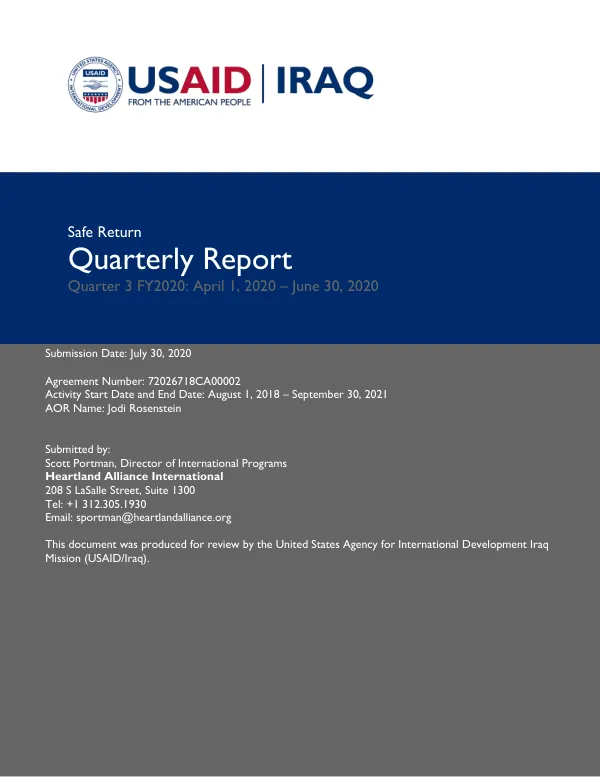
Safe Return Quarterly Report Quarter 3 FY2020: April 1, 2020 – June 30, 2020
The Safe Return project is a pilot initiative aimed at assisting internally displaced persons (IDPs) from minority communities in the Ninewa Plains of Iraq who are survivors of severe human rights abuses to return and reintegrate into their communities of origin.
2020 · 51 pages
Sign in to readA free account is required to download.
Abstract
The project, which began on August 1, 2018, and is set to conclude on September 30, 2021, is implemented by Heartland Alliance International (HAI) with funding from the United States Agency for International Development (USAID). The project's primary objective is to reduce fear of violence and accelerate IDP return by providing holistic services using a community-based torture treatment model, rapid identification and response to localized security problems, and access to transitional justice initiatives for survivors who voluntarily seek to bring civil or criminal actions against perpetrators. The project targets approximately 800 primary survivors of severe human rights abuses and 4,000 family members and dependents, with the goal of increasing the willingness of IDPs to return to their communities of origin. The project's implementation plan was revised in May 2020 to incorporate updated indicators and a revised Monitoring, Evaluation, and Learning (ME&L) plan. On June 18, 2020, HAI received a No-Cost Extension until September 30, 2021, as well as its full obligation of an additional $1.1 million USD for a total of $5.6 million USD for the life of the project. The project has achieved significant results to date, with notable progress in several key areas. In terms of case management services, 85% of minority IDPs reported satisfaction with the services, and 1,415 participants had at least 80% of their case management plan implemented. The project also provided specialized medical care services to 100% of referred participants, with 13,084 individuals receiving basic primary medical care and 8,044 individuals receiving sexual and reproductive health services. In addition, the project has made progress in providing psychosocial support services, with 837 participants receiving PSS services, and 70% of referred participants successfully receiving specialized mental health services. The project has also supported the establishment of new or existing businesses, with 9 individuals placed in new or existing businesses, and 988 individuals completing USG-assisted workforce development programs. The project has also made progress in addressing community-identified risks to return, with 88% of local authorities addressing these risks, and 17 human rights violation cases admitted to formal legal proceedings of national and international courts. The project has also supported the engagement of civil society organizations in advocacy interventions, with 8 organizations receiving USG assistance. Overall, the Safe Return project has made significant progress in its efforts to assist IDPs from minority communities in the Ninewa Plains of Iraq to return and reintegrate into their communities of origin. The project's holistic approach to addressing the needs of IDPs, including provision of case management services, medical care, psychosocial support, and economic empowerment, has been instrumental in achieving these results.