SUPPLY CHAIN MANAGEMENT SYSTEM
Safety in Transit: SCMS's Robust Security Measures for HIV/AIDS Product Deliveries
The Supply Chain Management System (SCMS) prioritizes safety in developing countries where public health programs are vulnerable to stock theft, counterfeit, and hazards on the road.
2012 · 3 pages
Sign in to readA free account is required to download.
Abstract
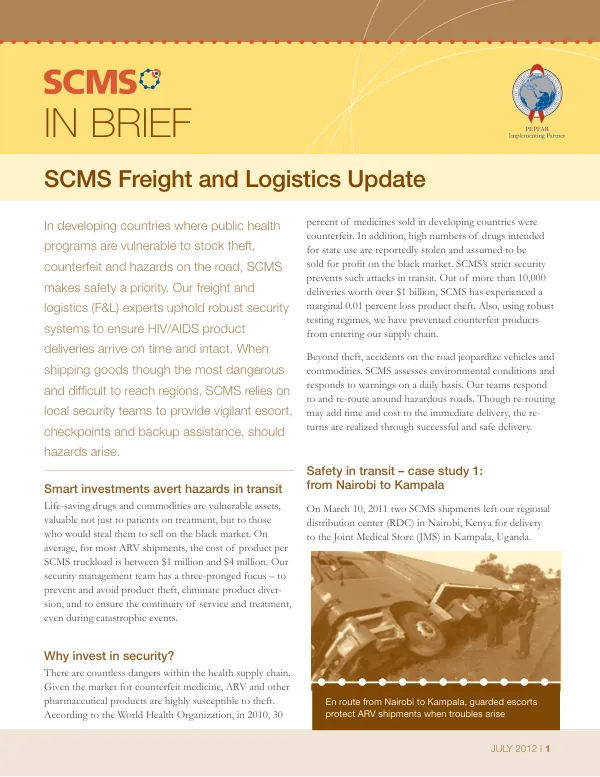
SCMS's freight and logistics experts uphold robust security systems to ensure HIV/AIDS product deliveries arrive on time and intact. When shipping goods through the most dangerous and difficult-to-reach regions, SCMS relies on local security teams to provide vigilant escort, checkpoints, and backup assistance. SCMS's security management team has a three-pronged focus: to prevent and avoid product theft, eliminate product diversion, and ensure the continuity of service and treatment, even during catastrophic events. The cost of product per SCMS truckload is between $1 million and $4 million, making life-saving drugs and commodities valuable assets vulnerable to theft. According to the World Health Organization, in 2010, 30 percent of medicines sold in developing countries were counterfeit. SCMS has experienced a marginal 0.01 percent loss of product theft out of more than 10,000 deliveries worth over $1 billion. Using robust testing regimes, SCMS has prevented counterfeit products from entering its supply chain. Beyond theft, accidents on the road jeopardize vehicles and commodities. SCMS assesses environmental conditions and responds to warnings on a daily basis, re-routing around hazardous roads to ensure successful and safe delivery. In a case study from Nairobi to Kampala, an armed escort accompanied two SCMS shipments worth over $1.5 million. After crossing the Kenya-Uganda border, the drivers proceeded with caution over roads recently damaged by rain. However, one of the vehicles lost control and veered off the road, crashing on its side. The security team acted swiftly to protect the vulnerable cargo from looting and prevent delays to the time-sensitive shipment. SCMS uses local partnerships to manage risk and maintain security. RTT, a South African logistics company, has provided world-class security for over 30 years with a formally trained staff of retired police, army, and safety officers. RTT's warehouses feature perimeter barriers, site lighting, secure entryways, and electronic entry control systems. SCMS's regional distribution centers (RDCs) in Kenya, Ghana, and South Africa are restricted to staff and approved visitors, with a strict division of duty between warehousing staff and transportation loading staff. All SCMS truck shipments are sealed by third-party security using an impenetrable lock-and-bolt, which is attached to a disposable lock that breaks to give indication of any tampering in transit. Depending on the value of shipment, third-party security partners also provide armed-guard escort during delivery. Security teams keep vigilant watch of goods from central situation rooms, with hourly calls to RTT's central security situation area in South Africa to give status updates on the shipment. Through coordination and partnerships, SCMS provides state-of-the-art security for a fraction of what it would cost to replace compromised products. Taking into account the potential risks to staff safety, program integrity, and treatment interruption for patients, security is a smart investment. SCMS has had zero stock losses through theft or pilferage since the project's start in 2005, with only three incidents of theft equating to $50,000 – 0.01 percent the total value of all deliveries.