USAID DEC
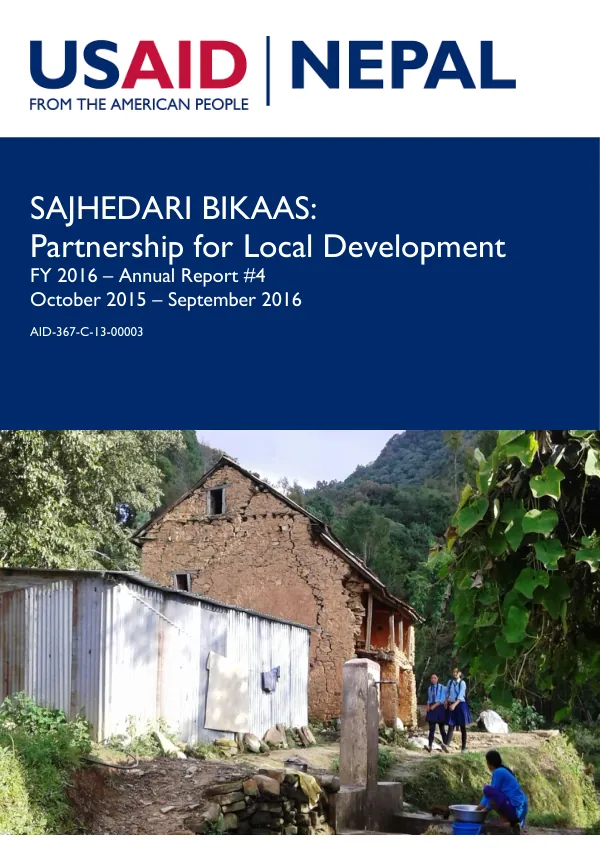
SAJHEDARI BIKAAS: Partnership for Local Development FY 2016 – Annual Report #4
The Partnership for Local Development, also known as SAJHEDARI BIKAAS, is a program focused on community development in Nepal.
2016 · 96 pages
Sign in to readA free account is required to download.
Abstract
The program operates under the umbrella of the USAID-funded initiative, with the primary goal of establishing an enabling environment for community development. The program's FY 2016 Annual Report #4, covering the period from October 2015 to September 2016, highlights key accomplishments and challenges faced during this period. The program's operational environment was marked by several challenges, including a blockade and fuel crisis, delayed formation of the National Reconstruction Authority, and ongoing political and ethnic tensions. These factors had a significant impact on the program's activities and progress. Despite these challenges, the program continued to make significant strides in achieving its objectives. One of the key objectives of the program was to establish and improve the enabling environment for community development. To achieve this, the program focused on institutionalizing early responses to address the causes and consequences of instability. The program also worked towards adopting enduring solutions to the problems that drive conflict. These efforts were reflected in the program's results, which showed a significant increase in the number of community members participating in decision-making processes and a corresponding decrease in conflict-related incidents. The program also made significant progress in improving communities' ability to access resources for development. This was achieved through the establishment of inclusive community strategic planning processes, which enabled community members to identify and prioritize their development needs. The program also supported the development of strategic community development plans, which outlined specific goals and objectives for community development. Additionally, the program worked with community-based organizations (CBOs) to advocate for needed resources, including financial, technical, and commodity support. Another key objective of the program was to improve community's ability to effectively implement inclusive development projects. To achieve this, the program institutionalized mechanisms for transparent administration of funds, adopted inclusive management systems, and established systems for sustainability. These efforts were reflected in the program's results, which showed a significant increase in the number of community members participating in project implementation and a corresponding decrease in project-related conflicts. The program also made significant progress in increasing the ability of existing and new government units to function effectively. This was achieved through the training of local government officials, who were equipped with the necessary skills and knowledge to carry out their mandates effectively. The program also supported the collaboration between local government units and CBOs/CSOs to identify local development priorities and engage in local government budget and planning processes. Despite the significant progress made by the program, several challenges and constraints were identified during the reporting period. These included staff turnover, which affected the program's ability to maintain continuity and consistency in its activities. The program also faced challenges related to the blockade and fuel crisis, which impacted the delivery of program services. Additionally, the program faced challenges related to the delayed formation of the National Reconstruction Authority, which affected the program's ability to access resources and support. The program's financial report for FY 2016 showed a total expenditure of $X, with a significant portion of the funds allocated towards program activities and personnel costs. The program's financial performance was affected by the challenges and constraints faced during the reporting period, including the blockade and fuel crisis. Overall, the SAJHEDARI BIKAAS program made significant progress in achieving its objectives during the FY 2016 reporting period. Despite the challenges and constraints faced, the program continued to make a positive impact on the lives of community members and contributed to the development of a more enabling environment for community development.