USAID DEC
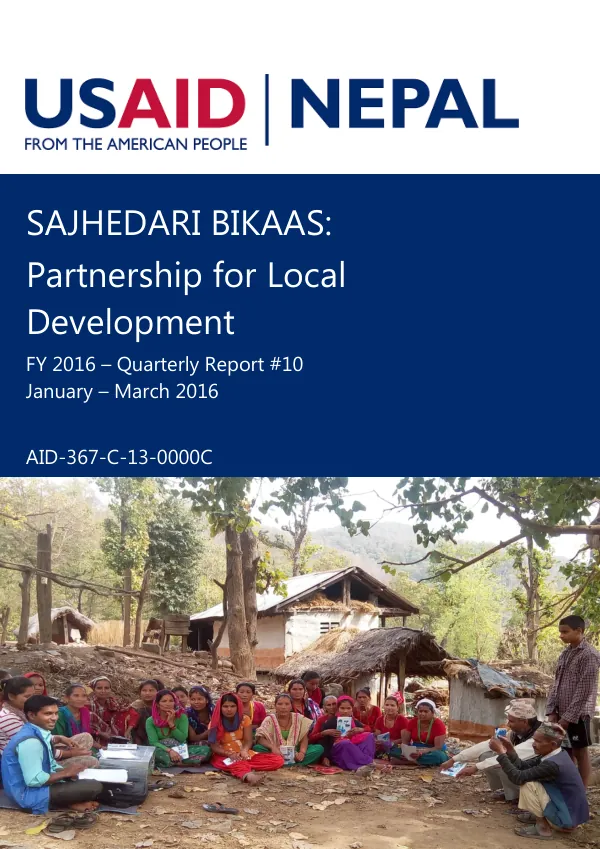
SAJHEDARI BIKAAS: Partnership for Local Development FY 2016 – Quarterly Report #10 January – March 2016
Sign inPACT
SAJHEDARI BIKAAS: Partnership for Local Development FY 2016 – Quarterly Report #10 January – March 2016
The Partnership for Local Development, also known as SAJHEDARI BIKAAS, is a program aimed at promoting community development in various districts of Nepal.
2016 · 81 pages
Sign in to readA free account is required to download.
Abstract
The program is funded by the United States Agency for International Development (USAID) and is implemented in collaboration with local government units, community-based organizations, and civil society organizations. The program focuses on four main objectives: establishing and improving the enabling environment for community development, improving communities' ability to access resources for development, improving communities' ability to effectively implement inclusive development projects, and increasing the ability of existing and new government units to function effectively. In terms of actual versus planned accomplishments, the program has made significant progress in establishing community mediation centers, conducting baseline assessments, and implementing community development activities. The program has also established inclusive community strategic planning processes and has facilitated the adoption of strategic community development plans. The program has also made progress in improving communities' ability to access resources for development, including the establishment of community-based organizations and the provision of financial, technical, and commodity support. Additionally, the program has improved communities' ability to effectively implement inclusive development projects, including the institutionalization of mechanisms for transparent administration of funds and the adoption of inclusive management systems. The program has also faced several challenges and constraints, including the fuel crisis, which has affected the program's operations and logistics. The program has also faced challenges in terms of youth development and has had to adapt its strategies to address these challenges. In terms of financial reporting, the program has expended significant resources on community development activities, including the establishment of community mediation centers and the provision of financial, technical, and commodity support. The program has also reported significant progress in terms of staff recruitment and utilization. The program has also reported progress in terms of community engagement and participation, including the establishment of community-based organizations and the facilitation of community development activities. The program has also reported progress in terms of gender and caste/ethnicity breakdowns, including the representation of women and marginalized groups in community-based organizations and community development activities. Overall, the SAJHEDARI BIKAAS program has made significant progress in promoting community development in various districts of Nepal. The program has established a strong foundation for community development and has made significant progress in terms of community engagement and participation, resource access, and project implementation. The program has also reported progress in terms of geographic information system (GIS) mapping, which has helped to identify areas of need and prioritize community development activities. The program has also reported progress in terms of organizational performance index, which has helped to assess the program's effectiveness and identify areas for improvement. In terms of specific achievements, the program has reported the establishment of 15 community mediation centers, the registration of 1,500 cases, and the resolution of 1,200 cases. The program has also reported the provision of financial, technical, and commodity support to 2,500 community-based organizations and the facilitation of community development activities in 20 districts. The program has also reported progress in terms of radio listeners' groups, including the establishment of 50 groups and the participation of 1,500 individuals. The program has also reported progress in terms of micro grants, including the awarding of 100 grants and the support of 500 community-based organizations.