SAVE THE CHILDREN FUND
Second Phase Readiness Assessment of Facilities Conducted in all Regions
The second phase of readiness assessment of facilities was conducted in all seven USAID/FBP's operational regions at the end of the first quarter, 2013.
2013 · 4 pages
Sign in to readA free account is required to download.
Abstract
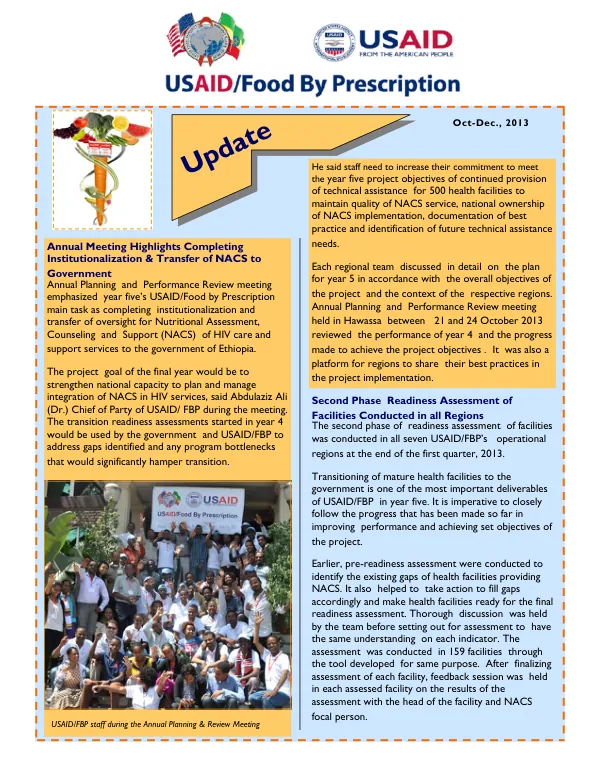
Transitioning of mature health facilities to the government is one of the most important deliverables of USAID/FBP in year five. It is imperative to closely follow the progress made so far in improving performance and achieving set objectives of the project. Earlier, pre-readiness assessments were conducted to identify the existing gaps of health facilities providing NACS. This helped to take action to fill gaps accordingly and make health facilities ready for the final readiness assessment. A thorough discussion was held by the team before setting out for assessment to have the same understanding on each indicator. The assessment was conducted in 159 facilities through the tool developed for the same purpose. After finalizing the assessment of each facility, feedback sessions were held in each assessed facility on the results of the assessment with the head of the facility and NACS focal person. The annual meeting highlights completing institutionalization and transfer of NACS to the government. The project goal of the final year would be to strengthen national capacity to plan and manage integration of NACS in HIV services. The transition readiness assessments started in year four would be used by the government and USAID/FBP to address gaps identified and any program bottlenecks that would significantly hamper transition. Each regional team discussed in detail on the plan for year five in accordance with the overall objectives of the project and the context of the respective regions. The annual planning and performance review meeting held in Hawassa between 21 and 24 October 2013 reviewed the performance of year four and the progress made to achieve the project objectives. It was also a platform for regions to share their best practices in the project implementation. The meeting emphasized year five's main task as completing institutionalization and transfer of oversight for NACS of HIV care and support services to the government of Ethiopia. Exemplary quality improvement in Debremarkos Health Center has improved the outcome of NACS for people admitted for treatment of severe and moderate malnutrition. Continuous quality improvement (CQI) principle implemented in the facility has improved the graduation rate, reduced non-respondent and lost to follow-up rates, and improved data record quality. The team identified problems impeding the overall performance of NACS, including minimal number of severely and moderately malnourished PLHIV having followed the plumpy'nut/plumpy sup treatment and brought about desired weight gain. The team devised a viable strategy to address the problems identified, including strong counseling on plumpy'nut/plumpy sup and components of nutrients and how it helps to recover malnourishment. After six months, significant changes were observed enabling the facility to double the graduation rate and reduce non-respondent and lost to follow-up rates. The management of the facility is also envisaging to further scale it up to improve its overall services. USAID/FBP presented findings on Nutritional Progress of Severely Malnourished HIV Positive Adults on Clinical Nutrition Care in Ethiopia at the 17th ICASA 2013, held in Cape Town 7-11 December 2013. The presentation highlighted the outcome of treatment with RUTF for severely malnourished adults, showing that there has been improvement of nutritional status as evidenced by change in average weight and Body Mass Index as well as change in nutritional status among others. Facility transition in Addis Ababa was conducted after readiness assessments and supervisory visits by USAID/FBP staff with involvement of relevant government health office representatives. A transition workshop was organized for mature facilities in Addis Ababa Region to give emphasis to the government's ownership of NACS implementation. Thirteen facilities were found to be mature from 21 facilities assessed in Addis Ababa region during the first quarter, and USAID/FBP formally transferred the technical support it has been providing on Dec.13,2013. Representative of the health bureau reiterated at the occasion that NACS would be handled fully by the government to strengthen its integration into health facilities HIV/AIDS care and support program. The transition workshop was attended by representatives of regional health bureau and health offices of sub cities and woredas as well as heads and NACS focal persons of all the 21 assessed facilities.