USAID DEC
South Central and Puntland Emergency Response Program (SCAPE) Quarterly Report: October-December, 2012
Sign inMERCY CORPS INTERNATIONAL
South Central and Puntland Emergency Response Program (SCAPE) Quarterly Report: October-December, 2012
The South Central and Puntland Emergency Response Program (SCAPE) is a USAID-funded initiative implemented by Mercy Corps Somalia.
2012 · 17 pages
Sign in to readA free account is required to download.
Abstract
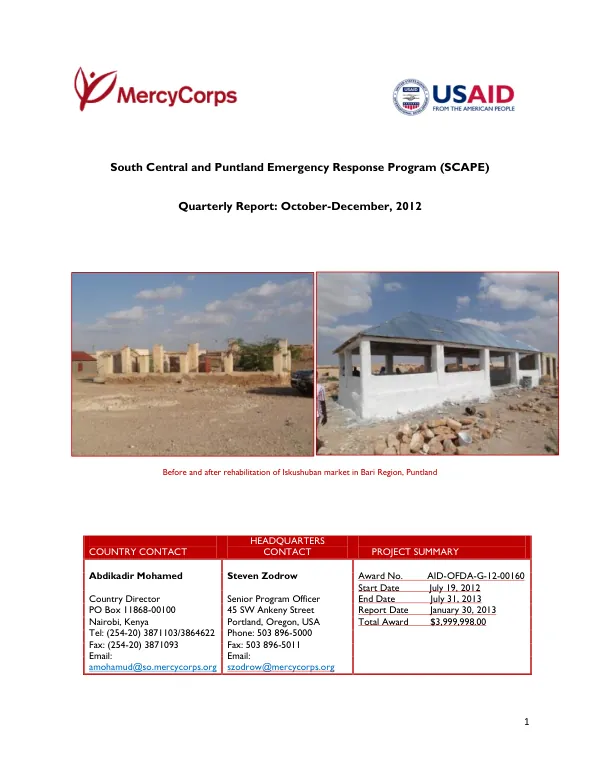
The program aims to support populations in both host communities and internally displaced persons (IDPs) to respond and cope with man-made and natural disasters. SCAPE targets communities and IDPs living in Mogadishu, Middle Juba, Lower Juba, Middle Shabelle, and Lower Shabelle in Southern Somalia, Galgadud and Galmudug regions in Central Somalia, and Bari and Karkaar regions in Puntland. The program has three sectors: Economic Recovery and Market Systems (ERMS), Water, Sanitation and Hygiene (WASH), and Protection. The ERMS sector focuses on rehabilitation of market infrastructure, including irrigation canals, river embankments, and surface dams. In the WASH sector, the program provides clean water, establishes sanitation facilities, and conducts hygiene promotion campaigns and Participatory Hygiene and Sanitation Transformation (PHAST) trainings. The Protection sector addresses gender-based violence (GBV) and trauma through Strategies for Trauma Awareness and Resilience (STAR) and GBV trainings. During the reporting period, the program engaged 2,069 beneficiaries through Cash for Work (CfW) to rehabilitate irrigation canals, river embankments, markets, and shallow wells. The CfW approach injects cash into the local economy and boosts the purchasing power of individual households. A total of USD $195,657 was transferred to 2,069 households during the reporting period. The program also distributed 1,114 CfW tools for future use. In the WASH sector, the program rehabilitated 23 shallow wells, seven berkads, and conducted five PHAST trainings and two hygiene promotion sessions attended by 315 participants. The berkads have a significant impact on communities, particularly in areas where they are the only source of water. PHAST and hygiene trainings targeted IDP camps and host communities in villages with rehabilitated water points. In the Protection sector, the program conducted three STAR and two GBV trainings in IDP camps for a total of 110 and 70 beneficiaries, respectively. There was an increase in GBV incidents reported by women and girls during the reporting period, largely attributed to security personnel conducting patrols. The program carried out six GBV sensitization and awareness raising meetings and four group counseling sessions during the quarter. The security situation in Puntland was heightened during the reporting period, affecting smooth program implementation. However, the program team managed to implement program activities and accomplish objectives, reaching both vulnerable IDPs and host community populations. Despite challenges, the program has made significant progress in addressing the needs of the target communities. The program has reached 11,284 beneficiaries this quarter, with 20.5% of the targeted 55,000 beneficiaries. The geographic areas targeted include Bari and Karkaar regions, Puntland, Galmudug and Galgadud regions, Central, Lower and Middle Shabelle, Lower and Middle Shabelle, Bay and Bakool regions in the South. The program has also made significant progress in rehabilitation of market infrastructure, including irrigation canals, river embankments, and surface dams.