GLOBAL COMMUNITIES
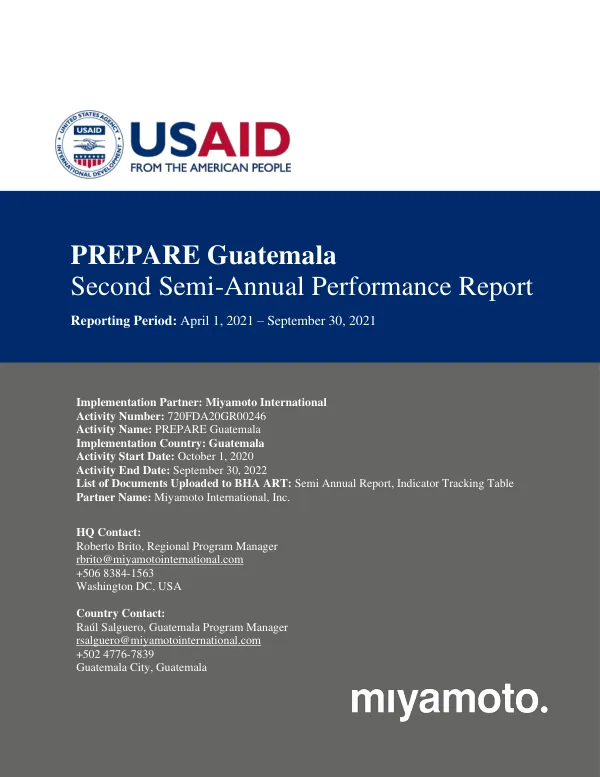
Second Semi-Annual Performance Report: PREPARE Guatemala
The USAID/BHA PREPARE Guatemala program aims to reduce vulnerability to seismic risk in the Guatemala City Metropolitan Area through targeted technical and capacity building assistance.
2021 · 16 pages
Sign in to readA free account is required to download.
Abstract
The program began on October 1, 2020, with a $1,000,000 budget and a two-year period of performance. The goal is to collect existing data on seismic hazard, generate new data on seismic exposure and vulnerability, and systematically analyze aggregated data for an improved understanding of seismic risk in Guatemala City. A segment of Guatemala City was selected for the seismic risk and vulnerability studies, covering a total area of 20 km2. The municipalities of Guatemala and Mixco participated in this selection, along with technical personnel from the Executive Secretariat of the National Coordinator for Disaster Risk Reduction (CONRED). The criteria for selecting the area included the existence of representative buildings of the entire city, such as popular housing, apartment and office buildings, public offices, hospitals, and first response facilities, shopping centers, and factories. The collection of exposure information began, including the definition of 37 sample polygons, divided into representative and special infrastructures. Building exposure data gathering was done with the collaboration of 15 final-year architecture students from Rafael Landivar University (URL). Subsequently, the structural characteristics of the buildings in the area were investigated with the collaboration of partner organizations that provided structural engineers for this purpose. The partner organizations were the Guatemalan Engineers Association (CIG) and the Engineering Faculty of San Carlos University. According to the assessment carried out at the beginning of the program, a probabilistic seismic hazard assessment (PSHA) was conducted to identify areas of high seismic hazard. The results of the PSHA were used to prioritize areas for further investigation and to inform the development of a seismic risk reduction strategy for the selected area. The strategy aims to reduce the vulnerability of buildings and infrastructure to seismic events, and to improve the preparedness and response of emergency responders to seismic disasters. The PREPARE Guatemala program is achieving its goal through a coordinated effort with partners, including the Government of Guatemala, Global Communities, and other organizations. The program is collecting and analyzing data on seismic hazard, exposure, and vulnerability, and is using this information to inform disaster risk management measures in the city's most vulnerable neighborhoods. Improved risk knowledge will be used to inform disaster risk management measures, including the development of building codes, emergency response plans, and public education campaigns. The program has made significant progress in the selected area, including the collection of exposure information, the investigation of building structural characteristics, and the development of a seismic risk reduction strategy. The program is expected to continue making progress in the coming months, with a focus on implementing the seismic risk reduction strategy and improving the preparedness and response of emergency responders to seismic disasters.
Related documents