USAID DEC
Seeding Labs & the USAID Global Development Lab: Building Scientific Infrastructure to Support the World’s Problem-Solvers
Sign inTHE UNIVERSITY OF ZAMBIA
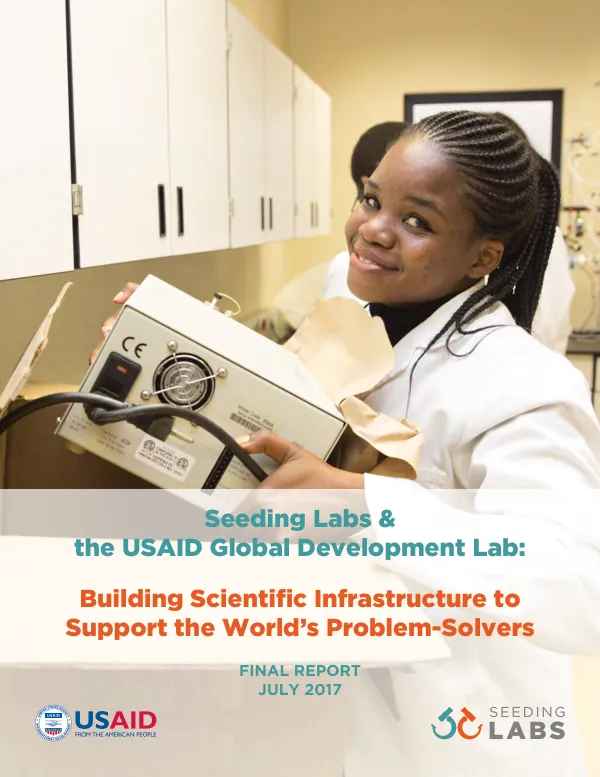
Seeding Labs & the USAID Global Development Lab: Building Scientific Infrastructure to Support the World’s Problem-Solvers
Seeding Labs, in collaboration with the USAID Global Development Lab, has been working to build a self-sustaining organization that can remove barriers to scientific discovery in low- and middle-income countries (LMIC) for development outcomes.
2017 · 41 pages
Sign in to readA free account is required to download.
Abstract
The organization's goal is to create a network of partners and develop an organizational structure that is efficient and flexible, enabling it to oversee operations at a higher tempo. The 3-year plan, supported by USAID's Global Development Alliance (GDA), was executed in three steps: investment and design in 2014, building capability and commencing implementation in 2015, and executing and full implementation in 2016 and 2017. The plan achieved the GDA's key strategic objectives, as detailed in the report. Seeding Labs' worldwide footprint in support of science in the developing world is depicted in Figure 1, and key accomplishments are summarized in Table 1. Seeding Labs has built a network of partners across various sectors, including academia, industry, and government. The organization has developed a standardized and streamlined process for instrumental access, including equipment sourcing, screening, matching, and shipping. This process has been optimized through rigorous testing and data collection, demonstrating both outcomes and impacts of the Instrumental Access program. The support from the USAID Global Development Lab has enabled Seeding Labs to develop unique competencies, including the process of screening and selecting equipment grantees, logistical procedures for equipment sourcing and shipping, and an ecosystem of partners committed to meeting the needs of scientists worldwide. These achievements have positioned Seeding Labs to grow beyond the original scope of Instrumental Access. The organization plans to grow through strategic partnerships with the private sector, leveraging the expertise developed through the GDA to fill a gap in the competencies of corporations. Seeding Labs is finding that its expertise aligns with the strategic business and social responsibility goals of many corporations, which are providing funding, lab equipment, and scientific expertise to match Seeding Labs' expertise. The partnership with Takeda's Access to Medicines unit is a model that will be expanded with other pharmaceutical companies, in part through an industry consortium with Takeda as the flagship member. Seeding Labs also sees a transformation of Instrumental Access from a program to a model, with lessons learned and procedures developed through working with academic institutions being transferrable to other types of laboratory settings. The organization is in discussions with potential partners about using the Instrumental Access model in various contexts, including industry and government settings. The Instrumental Access program has had a significant impact on the development of scientific capacity in LMICs, with over 26 shipments of equipment made to university partners and 22 shipments made to countries. The program has also leveraged USAID funds, with a leverage ratio of 2.82 in fair market value and 8.00 in replacement value. Employee growth has been significant, with the organization growing from 2 to 9 employees during the period of the GDA. The program has also had a positive impact on the development of research areas, with a focus on food safety, pest and disease resistance, air quality, clean water, climate change, energy, waste management, brain disorders, cancer, cardiovascular disease, chronic lung disease, diabetes, diagnostics, diarrheal diseases, drug discovery and development, HIV/AIDS, malaria, neglected tropical diseases, nutrition, and tuberculosis. The program has supported research in various countries, including Armenia, Cameroon, Colombia, India, Jamaica, Mexico, Nigeria, Peru, South Africa, Tanzania, Ukraine, Vietnam, and Zimbabwe. Overall, the Seeding Labs and USAID Global Development Lab partnership has made significant progress in building scientific capacity in LMICs, with a focus on removing barriers to scientific discovery and promoting development outcomes. The organization's growth and expansion plans, including strategic partnerships with the private sector and the transformation of Instrumental Access into a model, are expected to have a positive impact on the development of scientific capacity in LMICs.