JUÁREZ Y ASOCIADOS, INC.
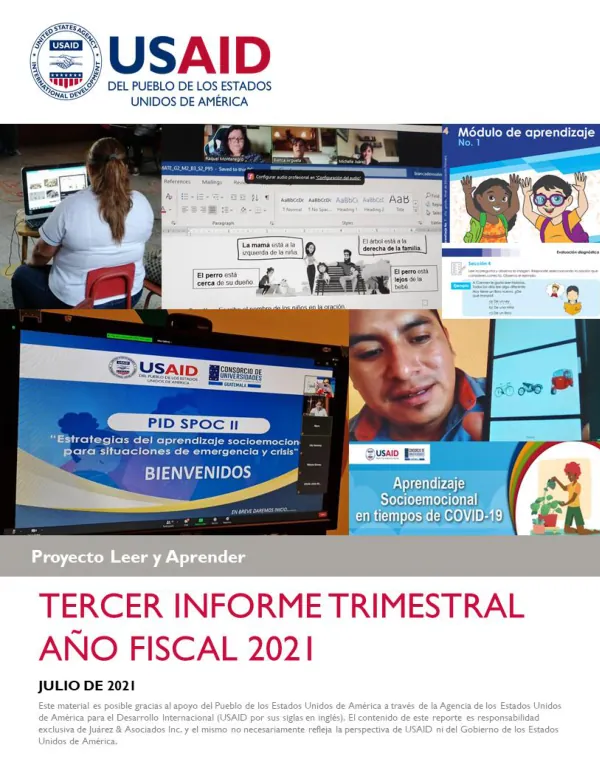
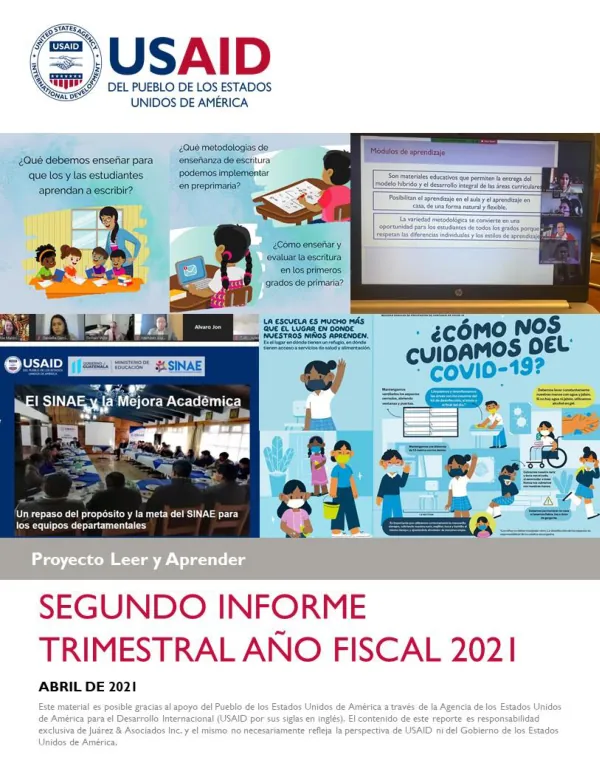
Segundo informe trimestral FY2021: Lifelong Learning Project
The Lifelong Learning (LLL) Project in Guatemala, implemented by USAID, aims to improve reading outcomes and increase quality educational access, particularly for children and indigenous youth aged 15 to 24 years old who are out-of-school.
2021 · 28 pages
Sign in to readA free account is required to download.
Abstract
The project's objective is to contribute to USAID's and the State COVID-19 Response Strategy Pillar 4, as well as the Ministry of Education's (MOE) Strategic Directions. During the fiscal year 2021 implementation period, efforts focused on collaborating with the MOE in designing and implementing the educational response to the coronavirus disease (COVID-19). Activities and technical assistance were responding to the requirements and priorities set by the government and MOE's authorities during the pandemic emergency. The LLL Project maintained close and constant communication with the MOE to establish requirements for technical assistance and to align them to activities for the start and development of the 2021 school year. The persistence of the pandemic guided the MOE's priorities to respond to educational context changes and promote learning under prevention measures and non-face-to-face modalities. The LLL Project readjusted and strengthened activities related to support resources for a hybrid modality of face-to-face and distance education, the adoption of prevention and health safety measures protocols, and different processes aimed at improving installed technical capacity. As part of Component I: Response and Recovery, the LLL Project provided technical assistance for the "Safe Back to School" protocols review, considering different users and educational contexts. Personnel from various MOE units and directorates at central and departmental levels participated in training spaces and received educational resources about the prevention measures and protocols' use and implementation. The project also coordinated and developed training and coaching processes for the National Educational Coaching System staff, aimed at effectively supporting planning for school return, monitoring the quality of educational delivery, and pedagogical coaching of reading and writing learning and teaching processes in bilingual and intercultural contexts. Support to alternative education continued through technical assistance on the Directorate for Alternative Education's requirements for decision-making and educational response planning. The LLL Project worked on the preparation of an alternative education services inventory, as well as on the rapid appraisal design for secondary education modalities availability in rural areas. Efforts to generate resources that can support teaching practice and promote learning continued, with progress made in the design of the Curriculum-Based Assessment on Writing and Mathematics formative assessment tools. The project also supported the development of learning modules aimed at second through sixth graders in the curriculum areas of Communication and Language and, Mathematics for the 2021 school year. Digital or mobile-designed applications were explored to identify resources that facilitate additional practice opportunities for students and teacher support material. In the next months, a plan will be developed to incorporate the use of the MatEprésate, GraphoGame, Read Along from Google, and Bloom Library apps. Activities of Component II: Preparation and planning included the definition and revision of quality criteria for alternative education educational resources. Technical assistance was provided to the Directorate for Educational Evaluation and Research on design, collection, analysis, and reporting processes of large-scale tests and assessments during confinement. The LLL Project worked on a set of diagnostic tests on reading, math, and writing for second through sixth grade, and secondary education. A pre-primary diagnostic test with socio-emotional learning aspects was also developed. Staff from the Directorate for Intercultural and Bilingual Education participated in training in the use of Bloom software and worked on generating new reading resources and on developing processes of interactive digital dictionaries in five Mayan languages: q'eqchi', kaqchikel, q'anjbo'al, mam, and k'iche'. The book "Enseñanza y aprendizaje de la escritura" (Writing Teaching and Learning) was presented publicly with more than 15,700 people, including educational authorities, key actors, education professionals, school principals, and teachers. The project continues supporting in-service teacher training through a grant allocated to the Consortium of Universities for Teacher Training in Guatemala. To prepare teachers to adopt alternative modalities in emergencies and crises, the consortium is working on a proposal to incorporate these elements and the use of digital platforms in teacher training curriculums.
Related documents